Behavior Growth V. behavior Change
Behavior growth works like a magnet
It pulls people forward, eliciting the best out of them.
Behavior change works like the two wrong ends of a magnet
It repels people, sending them into a primal defensive mode.
A White Paper by Molly Hughes Wilmer, CEO of Oyster Insight
Executive Summary
Seventy percent of strategy execution failures stem not from flawed strategy, but from leadership behavior gaps. Organizations invest billions in leadership development annually, yet the disconnect between leadership capability and business needs continues to widen—particularly in fast-moving environments where the pace of change outstrips traditional development approaches.
The problem isn’t that leaders lack commitment or capability. The problem is that most leadership development operates on a flawed premise: that leaders need to be changed.
This white paper introduces a fundamentally different approach grounded in behavioral science: behavioral growth rather than behavior change. Instead of trying to “fix” leaders or install new capabilities, behavioral growth uncovers and activates the strengths already present—what we call the pearl within.
Drawing on research in operant conditioning, self-actualization theory, neuroscience, and adult learning, we demonstrate why:
- Traditional behavior change creates resistance (people defend against being “fixed”)
- Behavioral growth creates momentum (people lean into their own potential)
- Embedded activation outperforms isolated training (85% of learning happens outside formal settings)
- Double-loop learning transforms beliefs, not just actions (creating sustainable shifts)
Through three real-world case studies—including a sales team that doubled its win rate and a post-acquisition company that broke down entrenched silos—we show how this principle translates into measurable business results: faster decision-making, higher engagement, strategic adaptability, and sustained performance improvements.
When strategy stalls, it’s rarely because people don’t care. It’s because leadership behavior hasn’t evolved fast enough. Behavioral growth closes that gap—not by changing who leaders are, but by activating who they already have the potential to become.
The Behavior Change Trap
Why Traditional Leadership Development Fails
Walk into any corporate training room and you’ll find engaged participants taking notes, nodding along, committed to applying what they learn. Return ninety days later and ask what stuck. The answer is sobering: most of it is gone.
This isn’t a motivation problem. It’s a science problem.
The Ebbinghaus Forgetting Curve
In the 1880s, German psychologist Hermann Ebbinghaus discovered something that still haunts leadership development today: people forget approximately 50% of new information within one day, and nearly 90% within a week unless that information is actively reinforced.
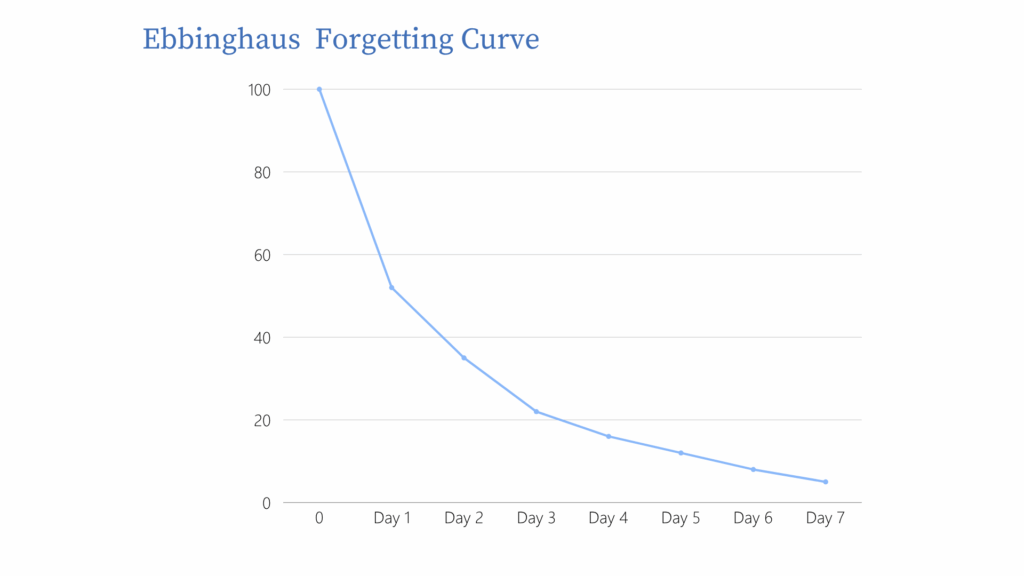
Traditional leadership training—workshops, off-sites, certificate programs—pours information into leaders during compressed timeframes, then sends them back to overwhelmed schedules with little structural support for application. The result? Learning evaporates before it can become behavior.
The 15/85 Gap
Research on adult learning reveals another uncomfortable truth: only 15% of knowledge acquisition happens in formal learning settings. The remaining 85% occurs through:
- Doing: Applying skills in real work contexts (70%)
- Connecting: Learning from others through observation and collaboration (20%)
- Reflecting: Processing experience through coaching, journaling, and structured reflection (10%)
Yet most leadership development budgets remain heavily weighted toward that 15%—workshops, courses, conferences—while largely ignoring the 85% where actual learning happens.
This structural misalignment explains why organizations can invest heavily in leadership development and still see minimal behavior change. They’re pouring resources into the smallest leverage point while neglecting the largest.
The Hidden Cost of “Fixing”
Perhaps the most insidious problem with traditional approaches is psychological: they position leaders as broken things requiring repair.
When development programs are framed around “fixing” gaps, “correcting” weaknesses, or “installing” missing capabilities, they trigger defensive responses. Research in Self-Determination Theory shows that approaches perceived as controlling—where external authorities dictate what needs to change—undermine intrinsic motivation and create resistance.
Leaders comply enough to check the box. They rarely internalize enough to transform.
The Executive Attention Problem
There’s another structural flaw in traditional leadership development that’s rarely discussed: canned training programs compete—and lose—against the urgent priorities that define executive life.
Send a C-suite leader to a two-day workshop and you’ve removed them from:
- Board prep and investor communications
- Strategic decisions that can’t wait
- Client escalations requiring senior attention
- Organizational crises that emerge without warning
Even when executives attend with good intentions, their attention is fractured. They’re monitoring email between sessions, taking calls during breaks, mentally prioritizing what they’ll tackle the moment they return. Research on divided attention shows that multitasking reduces comprehension and retention by up to 40%—meaning executives absorb even less than the already-low baseline retention rates suggest.
Worse: canned programs can’t customize content based on what actually motivates each leader. A CFO driven by operational excellence has different priorities than a CTO driven by innovation. A leader managing rapid growth faces different challenges than one navigating consolidation. Generic content—designed for “all leaders”—resonates with none.
These factors don’t just reduce ROI. They compound the already-low effectiveness statistics:
- Start with 50-90% knowledge loss within a week (Ebbinghaus)
- Add 40% comprehension reduction from divided attention
- Layer in motivation gaps from non-customized content
- Factor in zero structural support for post-training application
The result: organizations invest six figures in executive development and capture single-digit percentage returns on behavior change.
This isn’t a training quality problem. It’s a structural design problem—one that behavioral growth solves by embedding development inside executives’ actual work, customizing focus areas based on individual context, and eliminating the competition between “learning time” and “leading time.”
When growth happens in the flow of work, executives don’t choose between development and priorities. They develop through their priorities.
From Tactics to Strategy: When Rigid Plans Meet Unstable Reality
Consider a technology team we worked with—leaders who had built their careers on meticulous long-range planning. They excelled at breaking down complex initiatives into detailed milestones, managing dependencies, and executing against timelines.
Then their market shifted. Competitors pivoted faster. Customer needs evolved unpredictably. Acquisitions introduced new technologies. The very discipline that had made them successful—their tactical precision—became a constraint. They kept asking: “What’s the plan?” when the real question was: “What principles should guide us when plans become obsolete?”
Traditional behavior change would have sent them to a workshop on “strategic thinking” or “agile leadership”—essentially telling them their expertise was wrong and they needed to become different people.
Behavioral growth took a different approach.
Instead of trying to replace their tactical strength, we helped them identify universal principles that could guide decision-making when circumstances changed:
- Does this opportunity align with our core mission?
- Does this vendor/acquisition meet our criteria for strategic value?
- Does this pivot leverage our differentiating strengths?
These weren’t abstract concepts taught in a classroom. They were principles extracted from the team’s own experience, refined through dialogue about real decisions they faced, and embedded into their existing rhythms—weekly standups, quarterly reviews, opportunity assessments.
Within ninety days, the shift was measurable: decision-making accelerated. Leaders stopped waiting for perfect plans and started making confident strategic calls based on principle, not prescription. They remained mission-true while becoming strategically adaptive—not because someone changed them, but because someone helped them grow into who they already had the capacity to become.
The tactical precision didn’t disappear. It became embedded within strategic clarity—amplifying rather than replacing their existing strengths.
The Pearl Within: Our Guiding Principle
What Behavioral Growth Really Means
There is a pearl within every leader.
Not a deficit requiring correction. Not an empty vessel requiring filling. Not a problem requiring fixing. A pearl—something valuable, already formed, waiting to be discovered and brought to light.
This is the foundational principle that separates behavioral growth from behavior change:
Behavioral growth assumes leaders already possess the capabilities needed for excellence. The work is not to install something missing, but to uncover, activate, and amplify what’s already present.
This isn’t semantic wordplay. It’s a fundamentally different approach grounded in decades of research on human motivation, learning, and performance.
The Neuroscience: Why Uncovering Beats Changing
When we try to change people—to make them adopt behaviors that feel foreign or corrective—we activate threat responses in the brain. The amygdala, responsible for detecting danger, interprets change-as-correction as potential threat. This triggers defensive reactions: resistance, rationalization, surface compliance without deep commitment.
Behavioral growth works with the brain’s natural wiring, not against it.
Research in positive psychology and neuroscience shows that strength-based approaches activate reward pathways in the brain—specifically, the release of dopamine, which reinforces behavior and creates motivation for continued growth. When leaders recognize existing capabilities being activated rather than deficits being corrected, they experience:
- Increased intrinsic motivation (Self-Determination Theory)
- Enhanced confidence and self-efficacy (Bandura)
- Greater psychological safety (Edmondson)
- Faster skill acquisition and retention (neuroplasticity research)
In practical terms: people grow faster when they’re building on strength than when they’re fixing weakness.
Positive Reinforcement and Operant Conditioning
B.F. Skinner’s research on operant conditioning demonstrated that behaviors followed by positive reinforcement are more likely to be repeated. This seems obvious, yet most leadership development violates this principle by focusing on what leaders are doing wrong rather than amplifying what they’re doing right.
Behavioral growth flips the script:
- Instead of: “You’re not strategic enough”
We ask: “When have you been most strategic? What made that possible? How do we create more of those conditions?” - Instead of: “Your communication creates confusion”
We ask: “What’s an example of when your communication created clarity? What was different about that moment?”
This isn’t about ignoring problems—it’s about solving problems by activating solutions that already exist within the leader’s own experience. Neuroscience confirms what Skinner discovered: brains learn faster through reinforcement of successful patterns than through punishment of unsuccessful ones.
Self-Actualization and Intrinsic Motivation
Abraham Maslow’s hierarchy of needs places self-actualization—the realization of one’s full potential—at the apex of human motivation. But Maslow was clear: self-actualization isn’t about becoming someone new; it’s about becoming more fully yourself.
This aligns with Deci and Ryan’s Self-Determination Theory, which identifies three core psychological needs driving intrinsic motivation:
- Autonomy: The need to feel ownership over one’s choices
- Competence: The need to feel effective and capable
- Relatedness: The need to feel connected to others
Behavior change—especially when externally imposed—violates autonomy and can threaten competence. Behavioral growth satisfies all three needs:
- Autonomy: Leaders discover their own path forward rather than following prescribed steps
- Competence: Existing strengths are validated and amplified
- Relatedness: Growth happens through connection—coaching, peer learning, collaborative reflection—rather than isolation
When these psychological needs are met, motivation becomes self-sustaining. Leaders don’t need external pressure to maintain new behaviors because the behaviors emerge from internal drive.
The Double-Loop Learning Advantage
Most leadership development operates at the level of single-loop learning: adjusting actions to solve immediate problems without questioning underlying assumptions.
Problem: Decisions are too slow.
Single-loop response: Create a faster approval process.
But what if slow decisions aren’t a process problem? What if they reflect deeper beliefs—fear of failure, lack of clarity about strategic priorities, or uncertainty about decision-making authority?
Double-loop learning—a concept developed by organizational theorists Chris Argyris and Donald Schön—questions the assumptions, beliefs, and mental models that drive behavior.
Problem: Decisions are too slow.
Double-loop question: What beliefs about risk, authority, or accountability are creating hesitation? How do we shift those beliefs?
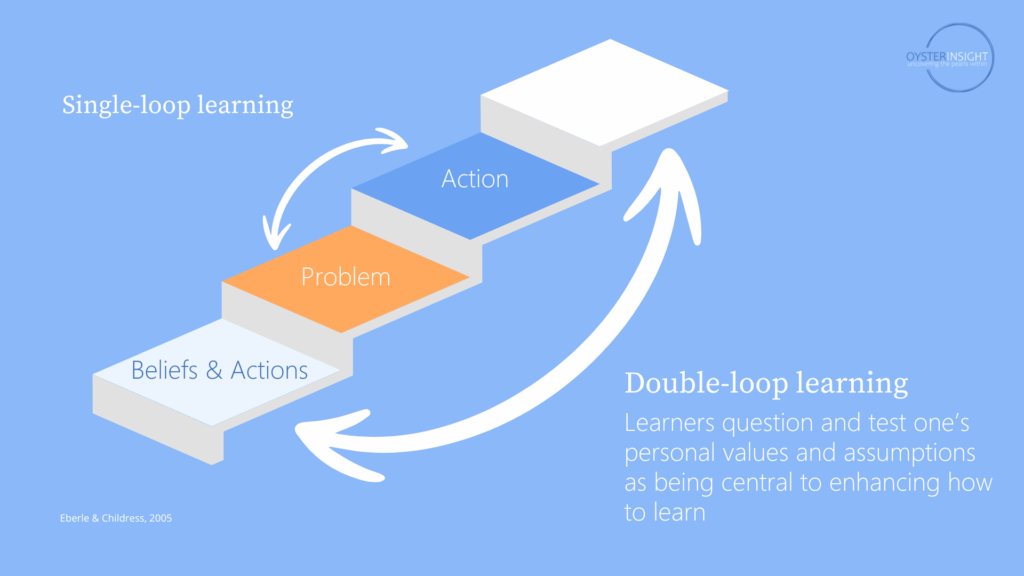
Behavioral growth operates at the double-loop level. We don’t just help leaders do things differently; we help them examine the beliefs that shape how they show up, then activate new beliefs that are already present but dormant.
In the case of the tactical team becoming strategically adaptive: the single-loop fix would have been “attend strategic thinking training.” The double-loop shift was uncovering their existing belief—clarity comes from detailed plans—and activating a more adaptive belief that was already within their experience: clarity can also come from principles that guide decisions when plans change.
They didn’t abandon who they were. They grew into a fuller version of themselves.
The Science That Makes It Work
Behavioral growth isn’t wishful thinking. It’s grounded in research on how adults actually learn, retain, and apply new capabilities—research that most traditional development ignores.
The Integrated Learning Model: Learn → Do → Connect → Reflect → Own
Real leadership development doesn’t happen in a workshop. It happens through a cycle that integrates five distinct modes of learning, with most of the growth occurring outside formal instruction.
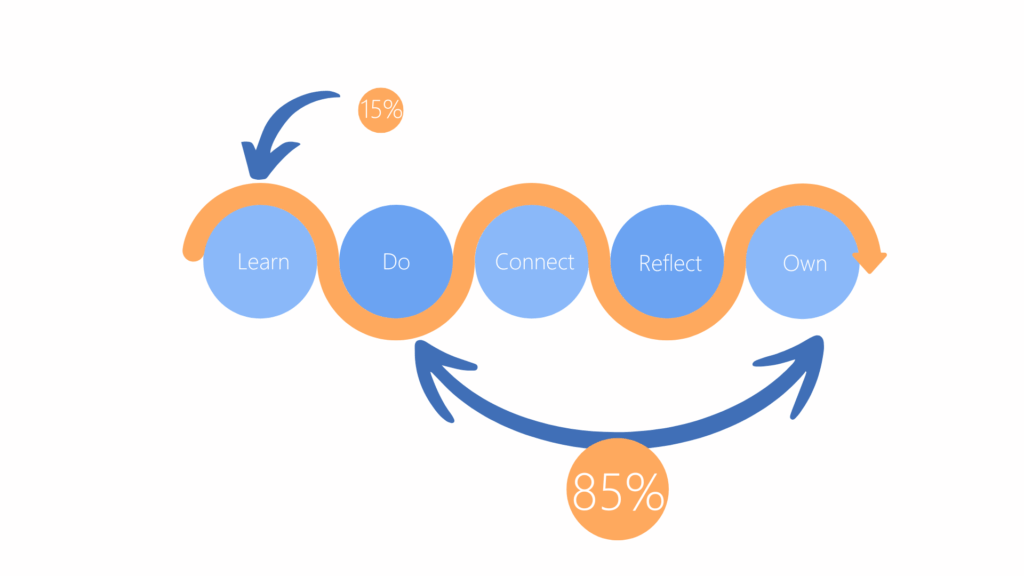
1. Learn (15%): Formal Knowledge Acquisition
This is where most development budgets go: workshops, courses, reading, lectures. It’s important—leaders need frameworks, models, and evidence-based practices. But learning alone doesn’t create behavior change.
Research confirms: only 15% of knowledge acquisition happens in formal settings.
2. Do (70%): Application in Real Work
The majority of learning—70%—happens through doing: applying new skills in real work contexts where stakes are real, feedback is immediate, and adjustments happen in the moment.
This is why traditional training fails: leaders attend a workshop, return to their desks, and face zero structural support for applying what they learned. Within days, the press of operational demands crowds out experimentation. The forgetting curve wins.
Behavioral growth embeds practice into real work. Instead of simulating leadership scenarios in a classroom, we help leaders activate new behaviors in actual meetings, decisions, and strategic conversations—with real-time coaching, feedback, and reinforcement.
3. Connect (10%): Social Learning
Another 10% of learning happens through social connection: observing others, peer coaching, mastermind groups, mentorship.
Adult learning theory emphasizes that we learn not just from our own experience, but from processing others’ experiences. This is why peer cohorts, where leaders share challenges and insights, often produce deeper growth than expert-led training.
Behavioral growth creates structures for connection—peer learning groups, mentor masterminds, collaborative reflection—ensuring leaders aren’t growing in isolation.
4. Reflect (5%): Processing Experience
Reflection converts experience into insight. Without structured reflection—journaling, coaching conversations, facilitated debriefs—experience becomes just activity, not learning.
Research shows that leaders who regularly reflect on their experiences retain more, adapt faster, and make better decisions. Yet reflection is often the first thing sacrificed when schedules get busy.
Behavioral growth embeds reflection into rhythm: brief post-meeting debriefs, weekly journaling prompts, monthly coaching check-ins that ask: What did you learn? What shifted? What’s next?
5. Own (Ongoing): Integration and Autonomy
The final stage—Own—is when new behaviors become internalized, automatic, and self-sustaining. This is where habit formation occurs.
Neuroscience research shows that it takes 18 to 254 repetitions for a behavior to become automatic—the range depending on complexity, context, and support. Traditional training offers 1-2 repetitions in a workshop, then expects habits to form. It doesn’t work.
Behavioral growth creates structures for sustained repetition: regular practice opportunities, accountability systems, feedback loops, and eventually internal support mechanisms (peer cohorts, AI coaching tools, mentor networks) that persist after external support ends.
This is how activation becomes ownership.
Why 85% Happens Outside Formal Training
The 70-20-10 model (originated by the Center for Creative Leadership) reveals a critical insight: the learning that sticks happens through doing, connecting, and reflecting—not through listening.
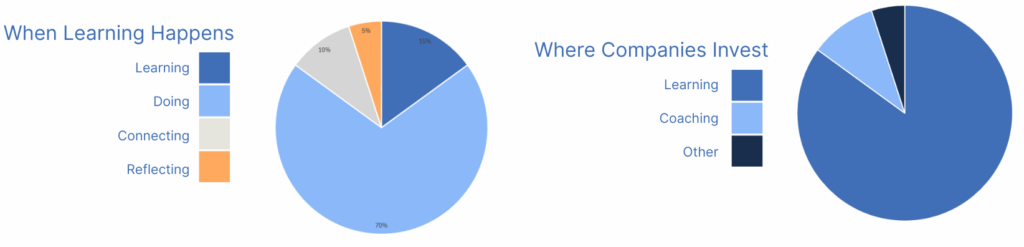
Most organizations structure development backward—investing heavily in the 15% (workshops, training programs) while leaving the 85% (on-the-job application, peer learning, reflection, habit formation) to chance.
This is why training doesn’t transfer.
Behavioral growth inverts the model. We use formal learning sparingly—just enough to introduce frameworks and create shared language—then invest the majority of time and attention in embedded application, social connection, structured reflection, and habit formation.
This approach aligns with how the brain actually learns. Neuroscience confirms: spaced repetition, varied application, and active retrieval (all characteristics of doing, connecting, and reflecting) produce stronger neural pathways than passive information absorption.
The Forgetting Curve and Repetition Science
Ebbinghaus’s research didn’t just identify the problem (rapid forgetting)—it also identified the solution: spaced repetition with active recall.
When new information is reviewed and actively applied at strategic intervals (1 day, 3 days, 7 days, 30 days), retention rises dramatically—from under 10% to over 80%.
But here’s what matters for leadership development: application is more powerful than review. Each time a leader practices a new behavior in a real context—making a strategic decision, facilitating a difficult conversation, reframing a problem—they’re not just reviewing information. They’re building neural pathways through experiential learning.
Habit formation research reinforces this. Studies show 18-254 repetitions are required to make a behavior automatic. Traditional training provides 1-2 repetitions in controlled settings. Behavioral growth provides dozens of repetitions in real contexts—supported by coaching, accountability, and feedback—until new behaviors become natural.
Double-Loop Learning: Changing Beliefs, Not Just Behaviors
Single-loop learning asks: What should I do differently?
Double-loop learning asks: What beliefs are driving what I currently do—and how might those beliefs need to shift?
Leadership behavior is downstream of beliefs. If a leader believes:
- “My job is to have all the answers” → they’ll micromanage and create bottlenecks
- “Vulnerability is weakness” → they’ll avoid difficult conversations and limit trust
- “Strategy requires perfect information” → they’ll delay decisions and miss opportunities
Traditional training tries to change the behavior (stop micromanaging, have difficult conversations, decide faster) without addressing the belief.
It rarely works—because the belief remains intact, pulling behavior back to baseline.
Behavioral growth works at the belief level:
- Instead of: “Stop micromanaging”
We ask: “What do you believe about your value as a leader? If your job isn’t to have all the answers, what is it? What would it look like to lead through questions rather than solutions?” - Instead of: “Have more difficult conversations”
We ask: “What do you believe about vulnerability and strength? Can you recall a time when being honest about uncertainty actually built trust?”
This is double-loop learning—questioning and testing assumptions, not just adjusting actions. When beliefs shift, behavior shifts naturally and sustainably.
Learner Autonomy Stages and Adaptive Support
Not all leaders are at the same developmental stage. Effective behavioral growth recognizes this and adapts support accordingly.
Based on Canning’s model of self-directed learning, adult learners progress through three stages:
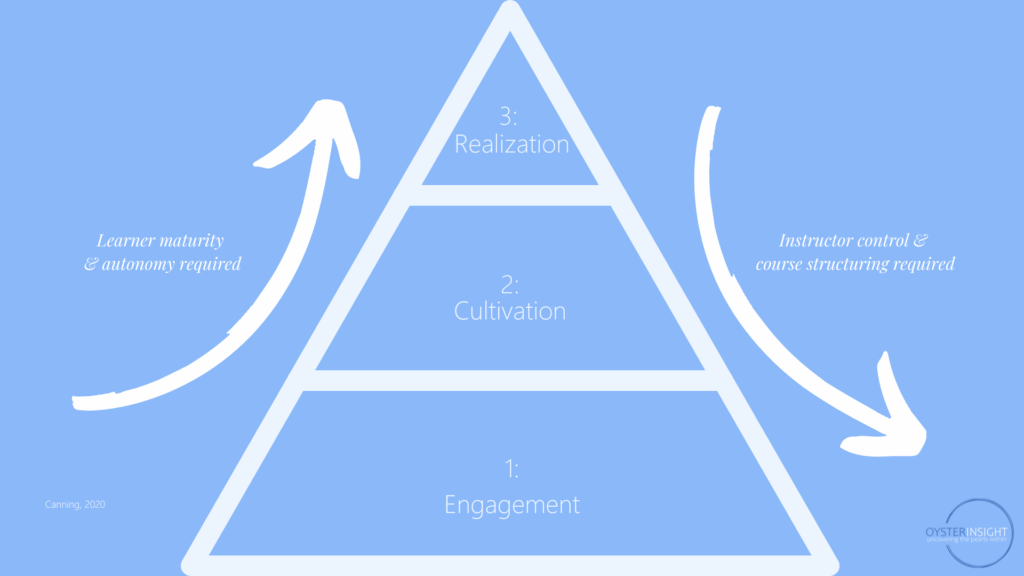
Stage 1: Engagement (High Instructor Support)
Early in development, leaders need structure, guidance, and clear frameworks. They benefit from explicit instruction, modeling, and frequent feedback. Autonomy is low; external support is high.
Stage 2: Cultivation (Balanced Support)
As leaders gain confidence, they need scaffolding that gradually releases control—guided practice with decreasing intervention, peer collaboration, and reflective coaching. Autonomy is increasing; support shifts
from directive to facilitative.
Stage 3: Realization (High Learner Autonomy)
Mature learners are self-directed—they identify their own growth edges, design their own experiments, and seek feedback proactively. External support becomes minimal; internal ownership is high.
Behavioral growth adapts to the leader’s developmental stage. Early on, we provide intensive coaching and structure. As leaders mature, we create peer learning systems and tools (mastermind groups, reflection frameworks, AI coaching) that sustain momentum without requiring ongoing external facilitation.
This is how six-month engagements produce lasting results—because by the end, leaders have internalized both the behaviors and the systems for continued growth.
How Behavioral Growth Addresses Contemporary Learning & Development Trends
The challenges we’ve outlined—retention loss, engagement gaps, competing priorities, disconnection from real work—aren’t unique to leadership development. They’re systemic problems facing all corporate learning and development in 2025.
Leading organizations are recognizing that traditional training models no longer work, and industry research consistently highlights the same trends Capital One, LinkedIn Learning, Docebo, and other thought leaders are prioritizing:
1. Knowledge Retention
The Ebbinghaus Forgetting Curve isn’t news—yet most L&D programs still operate as if knowledge delivered equals knowledge retained. Behavioral growth addresses retention through spaced repetition embedded in real work—not
artificial review cycles, but actual application opportunities that reinforce learning through doing.
2. Microlearning & Reducing Learner Fatigue
Multi-day workshops and semester-long programs create cognitive overload and calendar conflicts. Microlearning—short, targeted interventions—has emerged as the antidote. Behavioral growth operates in this mode naturally:
brief coaching touchpoints, focused peer conversations, real-time feedback after actual work moments. Learning happens in digestible increments that fit executive schedules rather than competing with them.
3. Increasing Engagement
Gamification, scenario-based learning, and social recognition can boost engagement—but nothing engages leaders more than solving real problems they’re facing right now. When development is embedded in actual strategic
decisions, client conversations, or team dynamics, engagement is inherent. Leaders aren’t playing games; they’re playing for keeps.
4. Learning in the Flow of Work
This trend—integrating development into daily routines rather than extracting people for separate training events—is exactly what behavioral growth operationalizes. The 85% of learning that happens through doing, connecting, and
reflecting must happen in workflow, not in classrooms. Organizations that master this integration see dramatically higher retention and application rates.
5. Hybrid and Flexible Work Innovations
Distributed teams make traditional in-person training logistics increasingly complex and expensive. Behavioral growth adapts naturally to hybrid environments because it’s embedded in existing rhythms—virtual check-ins,
asynchronous reflection, peer cohorts that meet digitally, real-time coaching during actual work moments. Development doesn’t require co-location when it happens inside the work itself.
6. Personalized Learning at Scale
AI-powered adaptive learning platforms promise personalization, but most still deliver generic content with minor customization. True personalization recognizes that each leader’s context, motivations, challenges, and strengths are unique.
Behavioral growth starts with systemic discovery—understanding not just “what leaders need to know” but “what’s blocking this specific leader’s growth in this specific context.” That level of customization can’t be algorithmically
generated; it requires human insight.
7. Agile Leadership and Navigating Uncertainty
Organizations are prioritizing leaders’ ability to navigate complex, volatile environments through scenario planning, dynamic risk management, and resilience. But traditional training that teaches “agile frameworks” misses the point:
agility isn’t a methodology you learn—it’s a capability you activate by practicing decision-making in ambiguous conditions with real-time feedback. Behavioral growth develops agile leaders by embedding practice in
actual uncertain contexts, not simulated ones. Leaders don’t learn about agility—they become agile by repeatedly making decisions when plans fail and circumstances shift.
8. Data-Driven Learning & Skill Analytics
Metrics matter—but measuring completions and quiz scores misses what actually matters: behavior change and business impact. Behavioral growth tracks observable shifts: decision velocity, engagement scores, collaboration
quality, strategic clarity. These aren’t learning metrics; they’re business performance metrics that demonstrate ROI in language executives understand.
9. Social and Collaborative Learning
Peer learning, cohorts, and communities of practice are increasingly recognized as high-impact, cost-effective development models. Behavioral growth builds these structures intentionally: mastermind groups for high-level
feedback, peer cohorts for support and shared learning, mentor networks that persist after formal programs end. This isn’t a nice-to-have add-on—it’s central to how activation becomes ownership.
10. AI Integration as a Growth Accelerator
Leaders are expected to leverage AI and advanced analytics for faster, smarter decisions—but technology alone doesn’t create decision-making capability. Behavioral growth uses AI strategically: custom GPT tools that
prompt reflection on decision patterns, analytics that surface blind spots leaders might miss, chatbots that reinforce key principles between coaching sessions. AI becomes a sustaining mechanism for human growth,
not a replacement for it. This positions leaders to make better decisions with AI support rather than becoming dependent on it.
11. Power Skills Development (formerly “Soft Skills”)
The term “soft skills” is increasingly recognized as outdated and misleading. These capabilities—emotional intelligence, collaboration, adaptability, communication, creative thinking, problem-solving—aren’t “soft” at all. They’re
power skills: foundational abilities that drive organizational success and increasingly rival or surpass technical expertise in business impact.
Leading organizations now use terms like power skills, human skills, or core skills to reflect their essential nature. Research consistently shows that in environments shaped by AI, automation, and rapid change, power skills become the primary differentiator between high and low performers.
Yet power skills remain the hardest to develop through traditional training. You can’t teach empathy in a workshop; you can activate it through guided practice in real relationships. You can’t lecture someone into adaptability; you create conditions where they practice navigating ambiguity with support and feedback.
Behavioral growth excels here precisely because it operates at the belief and behavior level, not the knowledge level. When leaders develop emotional intelligence, it’s not because they memorized a framework—it’s because they practiced reading room dynamics in actual meetings, received real-time feedback, reflected on what worked, and built new habits through repetition.
Power skills aren’t soft—they’re essential. And they require activation, not instruction.
12. Upskilling and Reskilling for Emerging Roles
As AI, automation, and market disruption reshape roles, organizations need leaders who can adapt quickly. But reskilling isn’t about installing entirely new capabilities—it’s about activating latent potential and helping leaders transfer existing strengths to new contexts.
This is behavioral growth’s core competency: uncovering what’s already there and amplifying it in service of new demands.
13. Addressing Burnout Through Strengths-Based Growth
Mid-level leaders face unprecedented burnout rates, driven in part by development approaches that feel like additional demands rather than investments in their success. Traditional training adds to calendars; behavioral growth integrates
with existing work. Traditional training highlights deficits; behavioral growth activates strengths. When leaders experience activation rather than remediation, psychological safety increases, autonomy is preserved,
and the development process itself becomes energizing rather than depleting. This isn’t just about retention—it’s about creating conditions where leaders thrive rather than simply survive.
Why Behavioral Growth Isn’t Just Another Trend
These trends aren’t passing fads—they reflect a fundamental shift in how organizations think about development: from knowledge transfer to behavior activation, from isolated training to integrated growth, from generic programs to personalized pathways.
Behavioral growth doesn’t chase trends. It operates from the principles that underlie them: how adults actually learn, how brains retain and apply information, how motivation works, how habits form, how organizations scale impact.
When you align with those principles, you’re not betting on the trend du jour. You’re building on neuroscience, psychology, and adult learning theory that have been validated across decades—and applying them in ways that emerging technology and contemporary work contexts make newly possible.
That’s the difference between a trend and a transformation.
Behavioral Growth in Action
Theory matters, but results matter more. Here are three real examples of how behavioral growth—uncovering the pearl within—translates into measurable business impact.
Case 1: From Competition to Collaboration
Challenge: A growing technology company had acquired multiple smaller firms to expand capabilities and market reach. On paper, the strategy was brilliant—each acquisition brought specialized expertise. In practice, it created chaos.
At operational levels, teams functioned as separate silos, competing for resources and recognition rather than collaborating. At the executive level, leaders remained divided over strategic direction—each protecting their legacy business rather than unifying around a shared vision.
Projects stalled in endless debate. Decision-making slowed to a crawl. High performers left, frustrated by infighting. The acquisitions that were supposed to accelerate growth were creating drag.
What traditional behavior change would have done: Sent executives to a “team alignment workshop” or implemented a new organizational structure to force collaboration—essentially telling leaders: “You’re working against each other; you need to change.”
What behavioral growth did: We started with a systemic discovery—not just interviewing executives, but examining how decisions actually flowed, where communication broke down, what incentives were creating competition, and what each acquisition uniquely contributed.
What emerged: every acquisition brought genuine strengths—specialized technical expertise, unique client relationships, proven delivery models. The problem wasn’t that teams lacked value. The problem was that no one had articulated a universal value proposition that recognized and integrated all those strengths.
Instead of forcing leaders to “align,” we facilitated a process where they discovered their own collective value:
- What makes each team uniquely valuable?
- How do these capabilities complement rather than compete?
- What universal value can we offer clients that none of us could deliver alone?
The result: a value proposition that recognized every team’s pearl—their distinctive contribution to the whole. Not generic corporate-speak, but specific language that each team could see themselves in.
Then we embedded this into real work: strategic planning sessions, client proposals, resource allocation decisions. Every time a competitive dynamic surfaced, we prompted: “How does this decision leverage our collective strengths? How does it honor each team’s unique value?”
Measurable Result:
Within six months, decision-making accelerated at all levels. Executives stopped protecting turf and started asking: “What’s the best collective solution?” Operational teams began cross-referring opportunities
rather than competing for them. Client feedback reflected a more coherent, capable organization.
The shift wasn’t forced. It was activated—by uncovering the value that was always present and creating structures that reinforced collaboration over competition.
Case 2: From Tactics to Strategy
Challenge: A technology leadership team had built their reputation on meticulous long-range planning—breaking complex initiatives into detailed milestones, managing dependencies, executing flawlessly against timelines.
Then their environment destabilized. Market shifts came faster. Competitors pivoted unpredictably. Customer needs evolved. New acquisitions introduced technologies that didn’t fit existing roadmaps.
The discipline that had made them successful—tactical precision—became a constraint. Leaders kept asking: “What’s the plan?” when the real question was: “How do we make good decisions when plans become obsolete?”
What traditional behavior change would have done: Sent them to “strategic thinking training” or “agile leadership” workshops—essentially telling them: “Your tactical expertise is wrong; you need to think differently.”
What behavioral growth did: We didn’t try to replace their strength. We built on it.
Through coaching and facilitated reflection, we asked:
- When have you made good decisions without a detailed plan? What guided you?
- What principles—not plans—have served you well over your career?
- If you couldn’t know the future, what criteria would help you evaluate opportunities?
What emerged: they already had strategic instincts—they just hadn’t formalized them. We helped them articulate universal principles for decision-making that could guide them when circumstances changed:
- Does this opportunity align with our core mission?
- Does this vendor/acquisition meet our criteria for strategic value?
- Does this pivot leverage our differentiating strengths or dilute them?
These weren’t abstract concepts taught in a classroom. They were principles extracted from the team’s own experience, refined through dialogue about real decisions they were facing.
Then we embedded these principles into existing rhythms: weekly standups, quarterly reviews, opportunity assessments. Instead of asking “What’s the plan?” they started asking: “Does this meet our decision criteria?”
Measurable Result:
Within 90 days, decision-making accelerated. Leaders stopped waiting for perfect plans and started making confident strategic calls based on principle, not prescription. They remained mission-true while becoming
strategically adaptive.
Their tactical precision didn’t disappear—it became embedded within strategic clarity, amplifying rather than replacing their existing strengths.
The pearl within: They were already strategic. They just needed permission and structure to trust that capability.
Case 3: From Knowledge to Performance
Challenge: A national sales team had strong product knowledge, solid training, and motivated individuals. Yet performance was inconsistent—some reps closed 60% of qualified opportunities while others hovered around 30%.
Leadership’s first instinct: more training. But the low performers had attended the same workshops as high performers. They knew the pitch, understood the product, could articulate value. Knowledge wasn’t the problem.
What traditional behavior change would have done: More training. Role-playing exercises. Sales script refinement. All focused on installing new techniques—assuming the gap was knowledge or skill.
What behavioral growth did: We observed actual sales calls (with permission) and conducted coaching conversations with both high and low performers.
What we discovered: high performers were already applying principles that low performers knew but weren’t consistently activating—active listening, asking strategic questions, connecting product features to specific client pain points, demonstrating confidence even in uncertainty.
The gap wasn’t knowledge. It was activation in real moments.
Instead of classroom training, we implemented embedded coaching: shadowing sales calls, providing real-time feedback, debriefing immediately after client conversations to reinforce what worked.
We also created peer learning cohorts where high performers shared not just techniques but mindset: What do you tell yourself before a difficult call? How do you handle objections without getting defensive? When do you walk away from a bad-fit opportunity?
These weren’t new techniques being installed—they were existing capabilities being activated through practice, feedback, and peer reinforcement.
Measurable Result:
Within six months, team win rate increased from 30% to 60%—not because salespeople learned something new, but because they consistently activated what they already knew in real client interactions.
The pearl within: The capability was always there. It just needed structure, reinforcement, and real-time activation.
Why This Matters Now
The pace of change isn’t slowing—and neither can leadership development.
The Cost of Slow Development
The Cost of Slow Development
Traditional leadership programs operate on 6-18 month timelines—multi-module curricula, spaced workshops, cohort graduations. Meanwhile:
- Markets shift
- Technologies disrupt
- Competitors pivot
- Strategic priorities evolve
By the time leaders complete a traditional program, the context has changed. The capabilities they developed may no longer be the capabilities needed.
Worse: high-potential talent won’t wait. In a competitive labor market, top performers expect visible growth opportunities. When development moves slowly—or worse, when it feels like “fixing” rather than growing—they leave for organizations that invest in their potential.
Research consistently shows: leadership quality and talent retention are directly linked. Organizations with well-developed, embedded leadership programs outperform peers by up to 25% in retention and 30% in innovation (Deloitte Human Capital Trends, 2024).
The cost of slow development isn’t just wasted training dollars—it’s lost talent, missed opportunities, and competitive vulnerability.
Organizations That Grow Leaders vs. Those That Train Them
There’s a fundamental difference between training and growth:
Training operates on a deficit model:
- Leaders have gaps
- Experts provide solutions
- Leaders implement prescribed behaviors
- Success = compliance with best practices
Growth operates on a strengths model:
- Leaders have potential
- Facilitators create conditions for activation
- Leaders discover their own path forward
- Success = sustainable behavior shifts aligned with authentic strengths
Organizations that train leaders see:
- Short-term knowledge gains that fade quickly
- Surface compliance without deep commitment
- Dependence on external expertise
- Limited transferability (what works in a workshop often fails in real context)
Organizations that grow leaders see:
- Sustained behavior shifts that compound over time
- Intrinsic motivation and ownership
- Self-directed development that continues after formal programs end
- Seamless integration (growth happens inside real work, not separate from it)
The gap is widening. Organizations that continue relying on bolt-on training are losing ground to those embedding growth into the rhythm of work.
The Leadership Imperative
Here’s the hard truth: when strategy stalls, it’s rarely because the strategy is wrong. It’s because leadership behavior hasn’t evolved fast enough to execute it.
You can have the best strategic plan, the most innovative technology, the strongest market position—and still fail if leaders can’t:
- Make decisions quickly in uncertain conditions
- Communicate with clarity across boundaries
- Build trust that enables collaboration
- Adapt to changing circumstances without losing strategic focus
- Activate their own potential and the potential of their teams
These aren’t skills you install through training. They’re capabilities you activate through growth.
The leadership imperative is this: accelerate the pace at which your leaders grow, or accept the pace at which your strategy stalls.
Behavioral growth makes this possible—by working with the brain’s natural wiring, embedding practice in real work, creating structures for sustained activation, and building on strengths rather than fixing deficits.
The result: leadership that keeps pace with change, execution that matches ambition, and organizations that don’t just survive disruption—they thrive in it.
Conclusion: The Pearl Within Every Leader
There is a pearl within every leader—something valuable, already formed, waiting to be discovered and brought to light.
The question isn’t: “How do we fix what’s broken?”
The question is: “How do we activate what’s already present?”
This white paper has explored the science behind that question—why behavioral growth succeeds where behavior change fails, and how organizations can create conditions for leaders to become the fullest versions of themselves.
The evidence is clear:
- Traditional training doesn’t stick (Ebbinghaus Forgetting Curve, 15/85 learning gap)
- Behavior change triggers resistance (neuroscience, Self-Determination Theory)
- Behavioral growth activates intrinsic motivation (positive reinforcement, self-actualization)
- Embedded activation produces measurable results (faster decisions, higher engagement, sustained performance)
But beyond the research, there’s a simpler truth: people grow faster when they’re building on strength than when they’re fixing weakness.
This doesn’t mean ignoring problems. It means solving problems by uncovering solutions that already exist—within leaders’ own experience, capabilities, and potential.
When a sales team doubles its win rate, it’s not because they learned something entirely new—it’s because they consistently activated what they already knew in real moments.
When a divided executive team breaks down silos, it’s not because they were forced to align—it’s because they discovered the collective value that was always present.
When tactical leaders become strategically adaptive, it’s not because they abandoned their strengths—it’s because they grew into a fuller version of themselves.
This is the pearl within: the potential that’s been there all along, waiting for the right conditions to emerge.
The Shift From Change to Growth
The implications of this shift extend far beyond semantics:
Behavior change asks: What’s wrong with you?
Behavioral growth asks: What’s right with you that needs more room to emerge?
Behavior change creates: Resistance, compliance, dependency
Behavioral growth creates: Momentum, ownership, sustainability
Behavior change measures: Knowledge gained, modules completed, certifications earned
Behavioral growth measures: Decisions accelerated, engagement increased, strategic clarity achieved
Behavior change operates: Outside of work, in artificial environments, at the pace of curriculum
Behavioral growth operates: Inside real work, in authentic contexts, at the pace of business need
The organizations that thrive in the next decade won’t be those with the most training programs. They’ll be those that create the conditions for continuous, embedded, strengths-based growth—where leadership development isn’t something that happens to people, but something that happens through them.
What Makes This Urgent
Three converging forces make behavioral growth not just preferable, but essential:
1. Accelerating Change
The pace of market disruption, technological advancement, and competitive pressure continues to increase. Leadership capabilities that take 12-18 months to develop through traditional programs become obsolete before they’re fully
formed. Organizations need leaders who can grow as fast as their environment changes.
2. Evolving Workforce Expectations
Today’s high-potential leaders—particularly those in mid-career—expect visible growth pathways, personalized development, and respect for their existing expertise. They won’t tolerate being “fixed.” They will invest deeply in organizations
that activate their potential. Talent retention depends on growth models that honor what leaders bring, not just what they lack.
3. The Power Skills Imperative
As AI and automation handle more technical and analytical work, the differentiating capabilities become distinctly human: emotional intelligence, strategic judgment, collaborative leadership, adaptive thinking. These power skills can’t be taught through content delivery—they must be activated through experience, practice, and reflection in real contexts.
Organizations that recognize these forces and adapt their development models accordingly will build competitive advantage. Those that don’t will continue investing in approaches that produce diminishing returns.
What’s Possible for Your Organization?
If you’re a leader reading this and recognizing patterns—strategy stalling despite good intentions, talent leaving despite strong culture, execution lagging despite clear direction—the gap likely isn’t strategy.
It’s behavior. And behavior can grow.
The question is: are you ready to shift from trying to change your leaders to activating the potential that’s already within them?
Questions to Consider
Before you invest in your next leadership development initiative, ask:
1. Does this approach honor existing strengths, or does it assume leaders are broken?
If the implicit message is “you’re not good enough,” you’ll trigger resistance rather than growth.
2. Does learning happen in real work contexts, or in artificial training environments?
If development competes with priorities rather than integrating with them, application will be minimal.
3. Are we investing in the 15% (formal training) or the 85% (doing, connecting, reflecting)?
If your budget is weighted toward workshops and courses, you’re funding the smallest leverage point.
4. Will leaders practice new behaviors 18-254 times, or 1-2 times?
If there’s no structure for sustained repetition, habits won’t form and behaviors won’t stick.
5. Are we developing behaviors, or transforming the beliefs that drive behaviors?
If you’re working at the single-loop level (actions) rather than double-loop (beliefs), change will be temporary.
6. Does this approach create dependency on external experts, or build internal capacity?
If leaders can’t sustain growth after formal programs end, you haven’t built ownership—you’ve rented compliance.
7. Can we measure results in business terms, not just learning metrics?
If success is defined by course completions rather than decision velocity, engagement, or strategic clarity, you’re measuring activity instead of impact.
If your current approach can’t answer these questions satisfyingly, it’s time to explore a different model.
A Different Conversation
We don’t believe in hard sells or prescribed solutions. Every organization’s context is unique—different challenges, different strengths, different strategic priorities.
What we offer is a conversation about what’s possible when you:
- Stop trying to change leaders and start activating their potential
- Stop separating development from work and start embedding it inside daily rhythms
- Stop measuring knowledge and start measuring behavior shifts that drive business results
If you’re curious about what behavioral growth might look like in your context—what blockers might emerge in systemic discovery, what principles would guide your leaders, what structures would sustain momentum—we invite you to explore.
No canned programs. No generic frameworks. Just a dialogue about uncovering the pearl within your leaders and creating the conditions for it to emerge.
Contact:
Molly Hughes Wilmer, CEO
OysterInsight
Molly@OysterInsight.com
449-994-1176
OysterInsight.com
The pearl is already there. Let’s bring it to light.
About Oyster Insight
Oyster Insight specializes in Future-Ready Leadership Activation™—a fundamentally different approach to executive development that drives measurable behavior growth in 90 days and scales sustainable leadership habits across teams and systems.
Our methodology is grounded in 25 years of field experience supporting leadership in over 350 organizations worldwide, combined with rigorous research in behavioral psychology, neuroscience, adult learning theory, and organizational development.
Unlike traditional training programs that extract leaders from their work, we embed growth directly into real business contexts—turning strategy sessions, team meetings, and critical decisions into development opportunities. The result: faster decision-making, higher engagement, stronger collaboration, and strategic clarity that persists long after formal programs end.
Our approach has consistently received top ratings (10/10) from C-suite executives for progress toward goals, expertise, and tangible value delivered.
We work with technology companies, professional services firms, and mission-driven organizations facing the challenges of rapid growth, market disruption, post-acquisition integration, and strategic transformation—anywhere leadership behavior is the difference between strategy that stalls and strategy that succeeds.
Core Offerings:
- Leadership Activation: 6-month embedded engagements that accelerate visible behavior growth in 90 days, then scale sustainable habits through internal structures
- Strategic Execution: Turning strategic clarity into coordinated action through embedded coaching, peer learning systems, and real-time accountability
- Executive Coaching: One-on-one partnerships focused on activating existing strengths in service of strategic objectives
References & Further Reading
This white paper draws on decades of research across multiple disciplines. For readers interested in deeper exploration:
Adult Learning & Development:
- Canning, N. (2020). “Self-Directed Learning in Adult Education”
- Center for Creative Leadership. “The 70-20-10 Rule for Leadership Development”
- Eberle, J. H., & Childress, M. D. (2005). “Patterns of Reflection: Single-Loop and Double-Loop Learning”
- Knowles, M. S. (1984). The Adult Learner: A Neglected Species
Behavioral Psychology:
- Skinner, B.F. (1953). Science and Human Behavior
- Clear, J. (2018). Atomic Habits: An Easy & Proven Way to Build Good Habits & Break Bad Ones
- Lally, P., van Jaarsveld, C. H. M., Potts, H. W. W., & Wardle, J. (2010). “How are habits formed: Modelling habit formation in the real world.” European Journal of Social Psychology
Motivation & Self-Determination:
- Deci, E. L., & Ryan, R. M. (2000). “Self-Determination Theory and the Facilitation of Intrinsic Motivation, Social Development, and Well-Being”
- Maslow, A. H. (1943). “A Theory of Human Motivation”
- Pink, D. H. (2009). Drive: The Surprising Truth About What Motivates Us
- Bandura, A. (1997). Self-Efficacy: The Exercise of Control
Neuroscience & Learning:
- Dweck, C. S. (2006). Mindset: The New Psychology of Success
- Rock, D. (2009). “Managing with the Brain in Mind.” Strategy+Business
- Medina, J. (2008). Brain Rules: 12 Principles for Surviving and Thriving at Work, Home, and School
- Ebbinghaus, H. (1885). Memory: A Contribution to Experimental Psychology
Organizational Learning:
- Argyris, C., & Schön, D. A. (1978). Organizational Learning: A Theory of Action Perspective
- Senge, P. M. (1990). The Fifth Discipline: The Art & Practice of The Learning Organization
- Edmondson, A. C. (2018). The Fearless Organization: Creating Psychological Safety in the Workplace
Leadership & Strategy Execution:
- Harvard Business Review (2023). “Why Strategy Execution Fails”
- Deloitte (2024). “Human Capital Trends: The Future of Leadership Development”
- LinkedIn Learning (2024). “Workplace Learning Report”
- Docebo (2024). “Learning & Development Trends Report”
Power Skills & Human-Centric Development:
- Goleman, D. (1995). Emotional Intelligence: Why It Can Matter More Than IQ
- Grant, A. (2021). Think Again: The Power of Knowing What You Don’t Know
- Brown, B. (2018). Dare to Lead: Brave Work. Tough Conversations. Whole Hearts.
© 2025 Molly Hughes Wilmer and Oyster Insight. This white paper is informed by research interviews with C-suite tech leaders and 25 years of field experience supporting leadership in over 350 organizations worldwide.
All case studies represent real client engagements with details anonymized to protect confidentiality. Results cited are based on documented client feedback and measurable business metrics tracked during engagements.
Appendix: Key Concepts Defined
Behavioral Growth: A development approach that assumes leaders already possess the capabilities needed for excellence, focusing on uncovering, activating, and amplifying existing strengths rather than fixing deficits or installing new capabilities.
Behavior Change: Traditional development approaches that identify gaps or weaknesses and attempt to install new behaviors through instruction, often triggering resistance and producing temporary compliance rather than sustainable transformation.
The Pearl Within: The metaphor representing the inherent potential, capabilities, and strengths present in every leader—valuable, already formed, waiting to be discovered and brought to light.
Double-Loop Learning: A learning approach that questions underlying beliefs, assumptions, and mental models (not just actions), enabling sustainable behavior shifts by transforming the thinking that drives behavior.
Single-Loop Learning: Adjusting actions to solve immediate problems without questioning the assumptions or beliefs that created those problems, producing temporary fixes rather than lasting transformation.
Embedded Activation: Integrating leadership development directly into real work contexts—meetings, decisions, strategic conversations—rather than extracting leaders for separate training events.
The 70-20-10 Model: Research-based framework showing that 70% of learning happens through doing (on-the-job experience), 20% through social learning (peers, coaching, observation), and only 10% through formal instruction.
Power Skills (formerly “soft skills”): Essential human capabilities including emotional intelligence, collaboration, adaptability, communication, creative thinking, and problem-solving—increasingly recognized as equal or superior to technical skills in driving organizational success.
Integrated Learning Model: The five-phase cycle (Learn → Do → Connect → Reflect → Own) that represents how adults actually acquire, practice, reinforce, and internalize new capabilities.
Systemic Discovery: An assessment approach that examines not just individual leaders, but the organizational systems (policies, procedures, incentives, communication flows, strategic alignment) that enable or constrain leadership effectiveness.
Learning in the Flow of Work: Contemporary L&D approach that integrates development into daily workflows and operational rhythms rather than competing with work through separate training events.
Microlearning: Short, targeted learning interventions (typically 5-15 minutes) that fit naturally into busy schedules and align with how the brain processes and retains information most effectively.
Agile Leadership: The capability to navigate volatile, uncertain, complex, and ambiguous (VUCA) environments through adaptive decision-making, resilience, and principle-based judgment rather than rigid planning.
Spaced Repetition: A learning technique that involves reviewing and practicing new behaviors at increasing intervals over time, dramatically improving retention and habit formation.