Introduction: Leadership Is Becoming More Nuanced
In conversations across tech, defense, and commercial industry, a clear pattern is emerging. Leaders are not just managing more work — they are navigating more complexity.
They are feeling pressure from all sides:
- accelerating speed of change
- rapid technical innovation
- rising expectations for productivity
- customers demanding precision and customization
- employees seeking meaning, value, and recognition
These forces are reshaping what leadership requires.
Leadership isn’t becoming heavier.
It is becoming more nuanced.
The pressures today are not about doing more. They are about thinking across more dimensions: strategy and execution, technology and culture, communication and clarity, innovation and stability, internal priorities and external mission.
Leaders can no longer excel solely inside a functional lane. The modern environment requires leaders who can think across domains, integrate perspectives, and leverage the complementary strengths of others.
This is Integrated Leadership — and it has become the leadership superpower of today.
The Five Critical Gaps Driving the Need for Integration
1. The Strategic–Tactical Divide
Organizations often slip into tension between big-picture strategy and day-to-day execution. But the root issue isn’t overload — it’s fragmentation.
We use the Five-Role Leadership Model to diagnose this divide:
- Directors clarify strategy
- Achievers drive execution
- Stabilizers strengthen systems and reduce risk
- Harmonizers build trust and cohesion
- Trailblazers drive innovation
Most leadership teams are missing at least one role. And the missing role becomes the bottleneck:
- Without Harmonizers, conflict lingers
- Without Stabilizers, chaos accelerates
- Without Trailblazers, innovation stalls
- Without Directors, priorities wander
- Without Achievers, nothing moves
Integrated leaders don’t attempt to be all five. They understand how the roles complement one another and build teams that balance them.
Integration is not about being superhuman.
It is about being super collaborative.
2. The Flattened Organization Trap
Across industries, leaders are under intense pressure to increase productivity. Boards want efficiency. Investors want margin expansion. Government partners want speed. Everyone is being asked to do more with less.
In these conversations, AI is often positioned as the answer.
But here is the reality many executives quietly share:
You cannot simply cut workforce and expect AI to pick up the slack.
Not without redesigning how the organization works.
Many teams have been restructured or downsized, but the surrounding systems have not been updated — workflows, decision rights, communication patterns, data flows, and expectations remain unchanged.
This creates the unseen burden inside nearly every organization:
The Integration Gap.
It is the space between how the organization is designed on paper and how people are actually doing the work day-to-day.
Inside that gap, employees quietly:
- absorb tasks no one reassigned
- rebuild outdated workarounds
- become default points of escalation
- fill missing coordination roles
- work after-hours to keep momentum alive
Leaders often assume the problem is capacity.
But the real problem is design.
Small, high-performing teams are possible.
But they require integrated workflows, integrated communication, and integrated leadership.
AI is not a replacement for people.
It is a multiplier — when the work is integrated.
3. The Crisis Response Breakdown
In a crisis, organizations that operate in silos typically react the same way: try everything at once, scramble for solutions, and create more confusion than clarity.
Integrated leaders take a different path:
- defining clear ownership
- running focused scenarios
- testing quickly and learning quickly
- communicating frequently and consistently
- making decisions with imperfect information
This collaborative clarity is what enabled certain nations and organizations to outperform others during COVID.
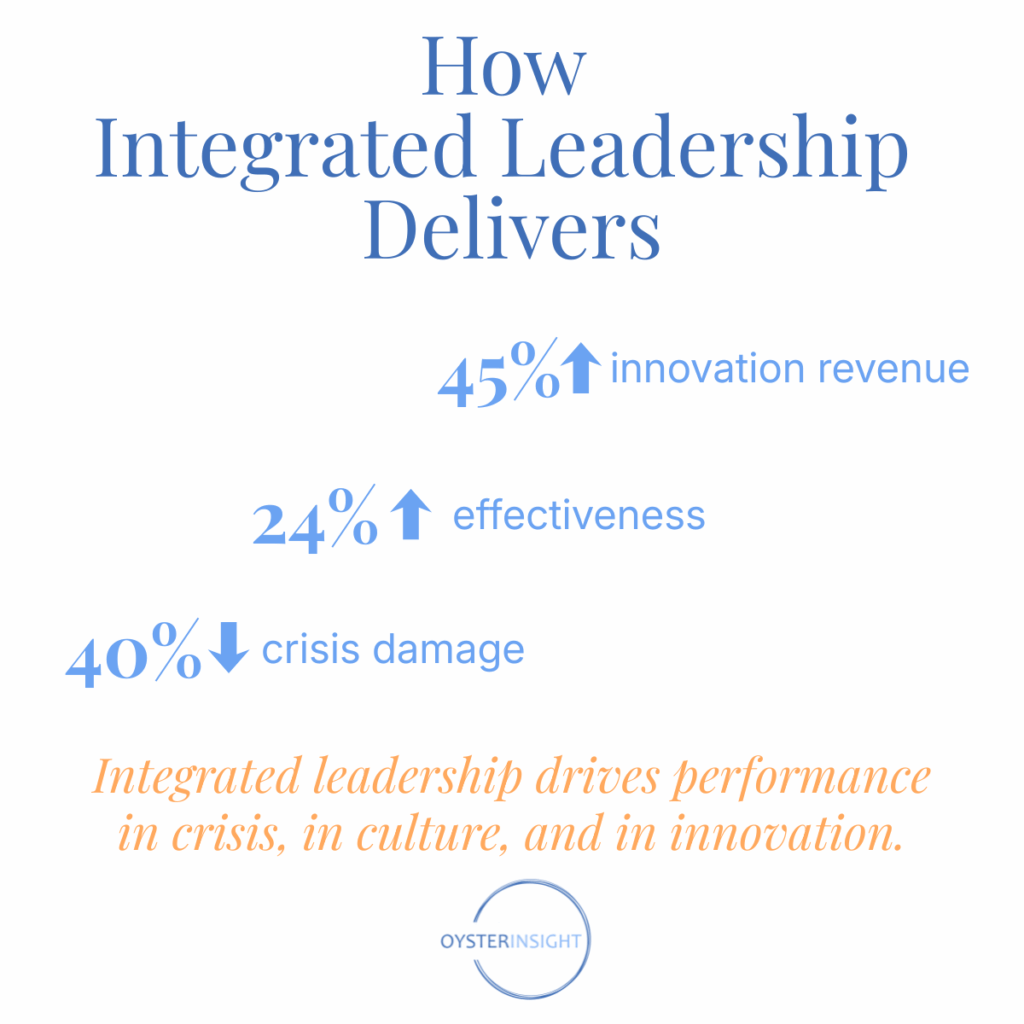
A global study highlighted by the World Economic Forum found that countries led by more integrated leadership profiles — leaders strong in both decisive task-focus and inclusive, relational power skills — experienced:
- approximately 40 percent lower COVID mortality
- significantly less economic damage
- faster recovery trajectories
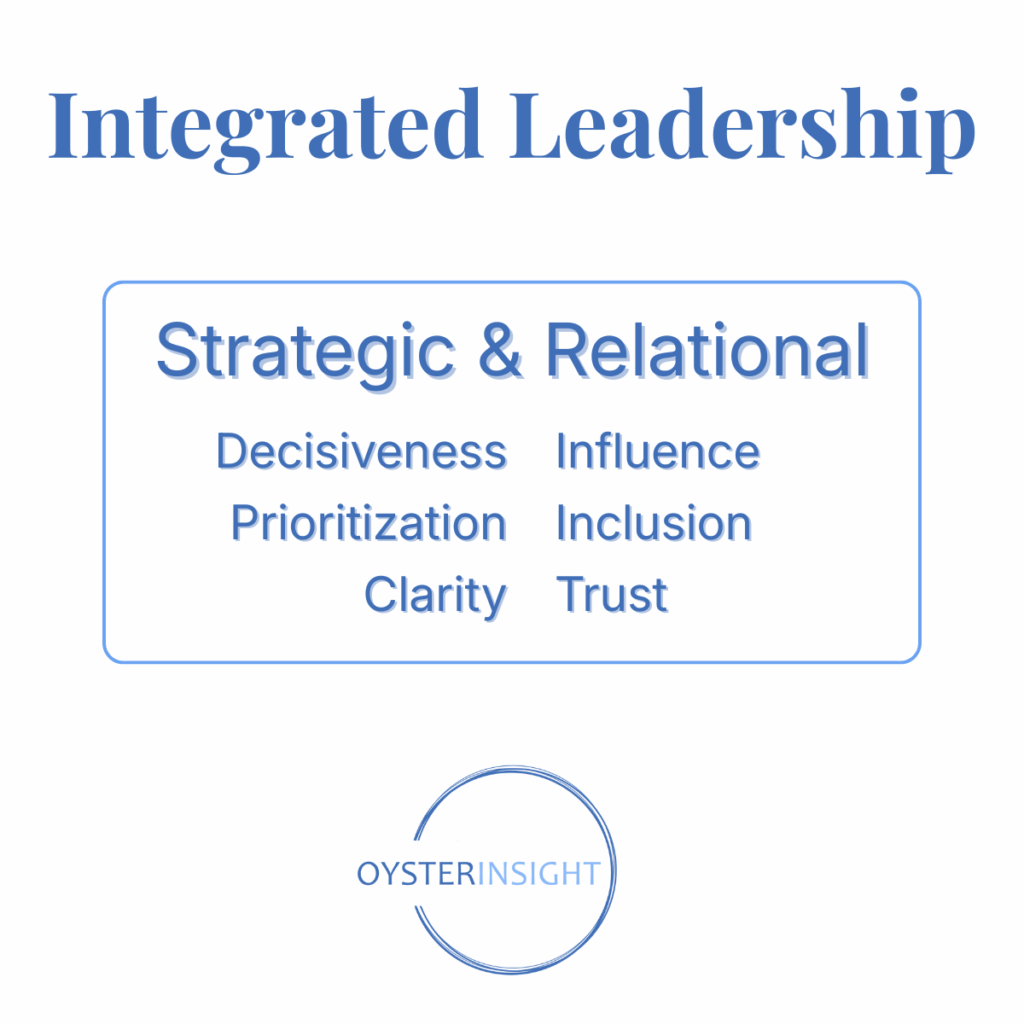
Integrated leadership blends decisiveness with connection.
The combination drives better outcomes.
4. The Technology–Culture Disconnect
The gap between technical capability and leadership capability is widening faster than any other.
Organizations are embracing AI rapidly — but adoption stalls when leaders treat AI as a tools problem rather than an integration challenge.
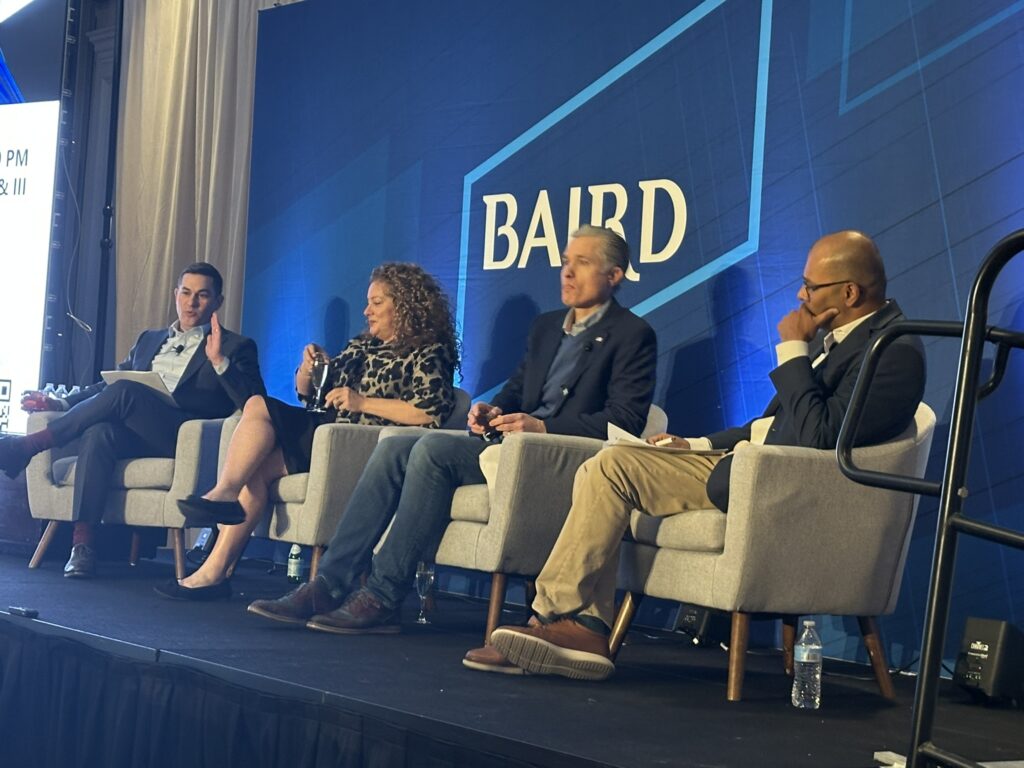
Katrina Mulligan of OpenAI notes that for AI to deliver real impact, organizations need two things.
Requirement One: A Systemic Organizational Approach
AI success requires:
- giving everyone desktop access
- building three to five AI-enabled workflows that people use daily
- leadership modeling usage from the top
Mulligan underscores that nothing predicts AI success more than this:
The extent to which the CEO uses AI is the single strongest indicator of the organization’s adoption trajectory.
AI is not a side project.
It is a cultural shift — and leaders must model the behavior.
Requirement Two: A Cultural and Behavioral Foundation
Mulligan points to a striking trust divide:
In the developing world, 72 percent of people trust AI.
In the developed world, only 32 percent do.
This gap is not technical in nature.
It is cultural, psychological, and behavioral.
Without relational and power skills — trust-building, communication, clarity, influence — AI initiatives stall, regardless of technical sophistication.
AI does not reduce the need for leadership.
It amplifies the need for integrated leadership.
5. The Community–Strategy Gap
Pittsburgh International Airport’s transformation demonstrates how integration enables innovation.
When CEO Christina Cassotis took over, the airport had declining traffic and only 36 destinations. She did not start by rewriting the strategy. She began by reconnecting:
- universities
- robotics companies
- business leaders
- government stakeholders
- airport employees
By integrating the ecosystem first, she created the conditions for innovation to take hold.
The result:
- 61 destinations
- a 25 percent increase in passenger traffic
- national recognition for transformation
Integration before innovation.
Always.
The Integration Advantage: Why It Outperforms
Integrated Leaders Deliver a Balanced Portfolio of Skills
Integrated leadership is not a style.
It is a balanced set of performance skills and relational power skills.
A global analysis of nearly 20,000 leaders in 69 countries found that leaders who integrate:
- autonomous strengths (drive, decisiveness, accountability)
and - relational power skills (empathy, inclusion, collaboration)
score 24 percent higher on overall leadership effectiveness.
Across a broader database of 130,000 leaders in 196 countries, top-performing leaders consistently cluster in this same integrated zone.
Integrated leadership is a measurable performance advantage.
Integrated Leaders Drive Engagement and Innovation
Gallup’s research shows:
- up to 70 percent of an employee’s engagement is determined by their immediate leader
- highly engaged teams deliver 17–21 percent higher productivity and profitability
And organizations with more diverse leadership — meaning more integrated cognitive, experiential, and relational strengths — generate:
- approximately 45 percent of revenue from new products and services
- EBIT margins nine percentage points higher than peers
Integrated leadership unlocks innovation and financial performance.
The Real Barrier: Leaders Who Can Only Operate One Way
Leadership challenges today do not arise from lack of talent.
They arise when leaders operate from only one mode and undervalue the perspectives outside their functional lane.
Some leaders default to:
- innovation over scale
- scale over innovation
- execution over imagination
- stability over speed
- performance over people
- or people over performance
None of these orientations are wrong.
They become limiting when held exclusively.
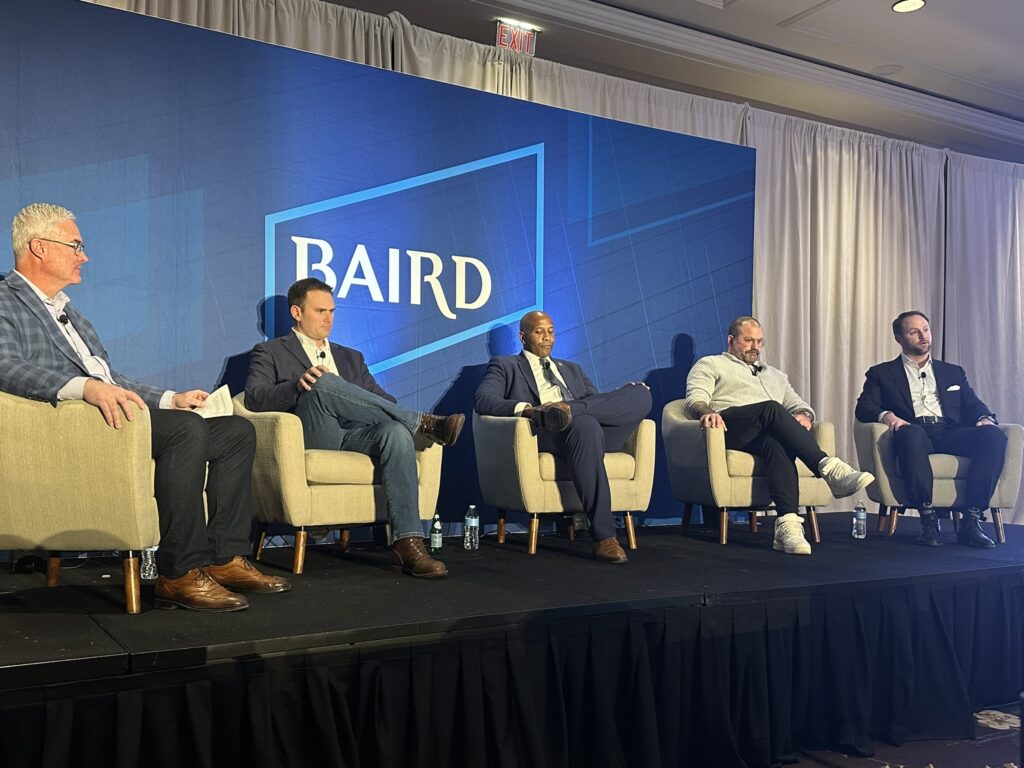
A powerful example comes from Josh Araujo, CEO of Forterra. His organization must excel in two demanding dimensions:
- producing high-quality products at scale
- driving continuous innovation in a fast-moving market
To enable focus, Forterra established two dedicated teams:
- one focused on scaling production and ensuring quality
- one focused on innovation and pushing boundaries
But the integration work happens at the executive level.
Araujo and his leadership team hold both realities:
- innovation must be manufacturable
- scale must stay agile
- investment must match feasibility and speed
- capacity must match ambition
- priorities must support both now and next
Integrated leadership is the ability to see the whole system and lead across its moving parts.
When leaders operate only one way, the system fractures.
When leaders integrate, the system accelerates.
Integrated leadership is the superpower that keeps organizations balanced, aligned, and forward-moving.
Practical Methodology: How Leaders Build Integration Capability
Step 1: Diagnose Role Gaps
Use the five-role model to identify which leadership capacities are overrepresented or missing.
Step 2: Align Ownership and Outcomes
Link tool-selection teams with the teams accountable for results.
Step 3: Integrate Before You Innovate
Redesign workflows, decision rights, and rhythms after restructuring.
Step 4: Build Cross-Functional Ownership
Refresh customer segmentation and integrate insights quarterly.
Step 5: Treat Executives as Equals
Shift from functional lanes to complementary, trust-based leadership.
Conclusion: Integrated Leadership Is the Superpower of Today
Leadership is not getting heavier — it is getting broader.
Organizations no longer need siloed experts or lone-hero executives.
They need leaders who can:
- think across domains
- integrate perspectives
- balance performance with relational power skills
- collaborate through complementary strengths
- align people, mission, and execution
Integrated leadership turns complexity into clarity, and speed into sustainable performance.
It is the leadership superpower of today.
Call to Action
If you want to understand your team’s integration gaps and strengthen the leadership capabilities that create the greatest impact, I’d be happy to sit down with you, learn what’s happening in your world, and explore tailored ways we can support your leaders.
Schedule a leadership integration audit or conversation.