🎥 Watch the Video: The Adaptation Imperative
Introduction: The Reinvention Clock Is Ticking
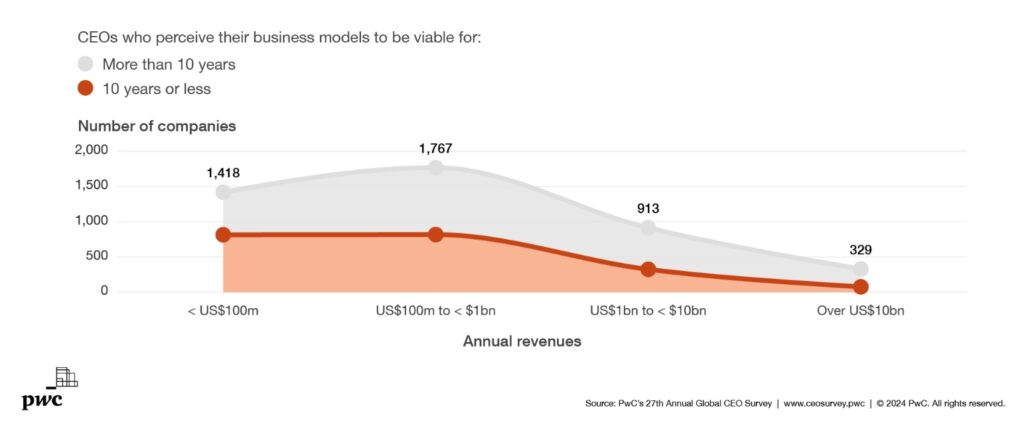
Forty-five percent of global CEOs now believe their companies will no longer be viable in ten years if they stay on the same path. That’s nearly half of the world’s most powerful executives quietly acknowledging a reality many feel but few say out loud: the pace of change has outstripped the pace of leadership adaptation.
For decades, leaders were asked to manage change. Then we shifted to navigate change.
Today, the mandate is far more urgent:
Adapt continuously — or fall behind decisively.
The speed, depth, and interdependence of today’s business environment are unprecedented. Technology cycles that used to take years now move in months. Regulatory shifts hit with cascading ripple effects. Customer expectations evolve before strategies even make it out of planning.
This is no longer a resilience problem.
Resilience helps you recover from disruption.
Adaptability helps you evolve because of it.
In this week’s blog, we’re going to break down:
- Why adaptation is different now
- The neuroscience behind why adaptation is hard
- A diagnostic to measure your adaptive capacity
- A practical, research-backed framework for building adaptability into your culture, systems, and leadership
And most importantly: what adaptive leaders do differently — not in theory, but in behavior.
Part 1: The Research — Why Adaptation Is Different Now
Every leader feels the pressure. The deadlines are tighter. The market conditions shift faster. The margin for error shrinks month by month. But the real force at play isn’t pressure — it’s compression.
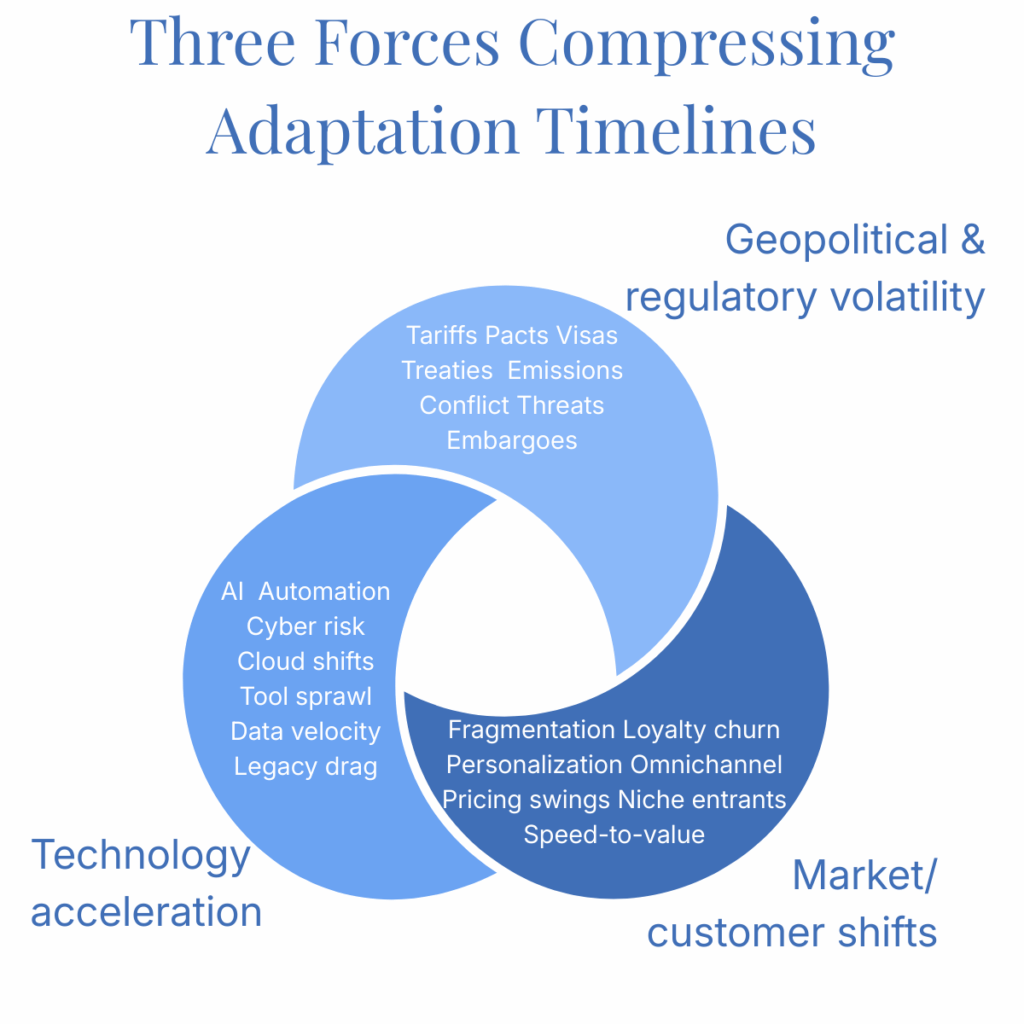
Three Forces Compressing Adaptation Timelines
1. Technology Acceleration
AI, automation, and data-driven decision engines are evolving exponentially, not linearly. Entire workflows are being redesigned in months, not years. This isn’t a “digital transformation project.” It’s a perpetual cycle of skill reinvention.
The leaders thriving today aren’t the ones mastering tools.
They’re the ones mastering adaptability around tools.
2. Geopolitical Volatility and Regulatory Shifts
Supply chains are reorganizing. National security requirements are tightening. Government contractors — increasingly balancing military vs. civilian priorities — face nonstop new compliance expectations. Leaders aren’t just navigating change; they’re navigating compounding change.
3. Market Fragmentation and Customer Expectation Evolution
Industries aren’t transforming uniformly; they’re splintering. Niche competitors rise faster. Customer expectations shift overnight. Brand loyalty erodes. The winners are the organizations adjusting fastest — not the ones with the biggest budgets.
The Cost of Slow Adaptation
Research shows that 48% of employees and 52% of leaders say their work has become chaotic and fragmented. The fragmentation isn’t because people aren’t working hard — they are. It’s because teams are reacting to change, not orchestrating it.
When adaptation lags:
- Teams work in parallel instead of together
- Meetings multiply rather than clarify
- Leaders default to crisis mode instead of forward motion
- Cross-functional disconnects widen
This is the hidden tax on modern organizations:
Running hard without moving forward.
The Adaptation Paradox
In the race to adapt, many companies inadvertently cut the very people they need most. They eliminate institutional knowledge. They reduce leadership depth. They widen capability gaps.
Research shows:
- 77% of organizations lack leadership depth
- 75% say their development programs don’t work
Organizations downsize to become “leaner,” but end up becoming more brittle. Because adaptation isn’t a headcount problem — it’s a leadership capability problem.
And capability isn’t built in classrooms.
It’s built in the work, during real execution, in real time.
Part 2: The Neuroscience — Why Our Brains Resist Adaptation
Even the most forward-thinking leaders feel the internal friction of reinvention. That’s not a character flaw — it’s neuroscience.
The Primal Wiring Problem
Humans are wired for survival, not strategy.
When uncertainty hits:
- The amygdala fires
- Threat signals escalate
- Tactical urgency overrides strategic thinking
- Leaders prioritize what feels safe, immediate, and controllable
This is why organizations become addicted to crisis mode. Crisis feels productive. It delivers dopamine hits. It creates the illusion of progress. But it blocks long-term adaptation.
The Cognitive Load Challenge
Adaptive thinking requires:
- Holding multiple scenarios simultaneously
- Prioritizing ambiguity
- Making decisions with incomplete information
- Integrating disparate inputs across domains
But under sustained uncertainty, our executive function bandwidth decreases. Context switching — which modern work conditions demand constantly — taxes the brain’s adaptability circuitry.
No wonder leaders feel stretched thin: the cognitive load of adaptation is structurally higher than the cognitive load of execution.
Building Adaptive Neural Pathways
Adaptability is a trainable skill because the brain is plastic – it’s called neuroplasticity.
Leaders grow adaptive capacity when:
- Psychological safety reduces threat response
- Repetition builds new neural patterns
- Reflection consolidates insight into behavior
- They “coach during the game” instead of waiting for perfect conditions
This is exactly why embedded leadership activation works.
You’re building adaptive neural pathways as the work unfolds, not in a vacuum.
Part 3: The Diagnostic — The Adaptive Leadership Audit
Here are five research-backed questions to evaluate your organization’s adaptive capacity.
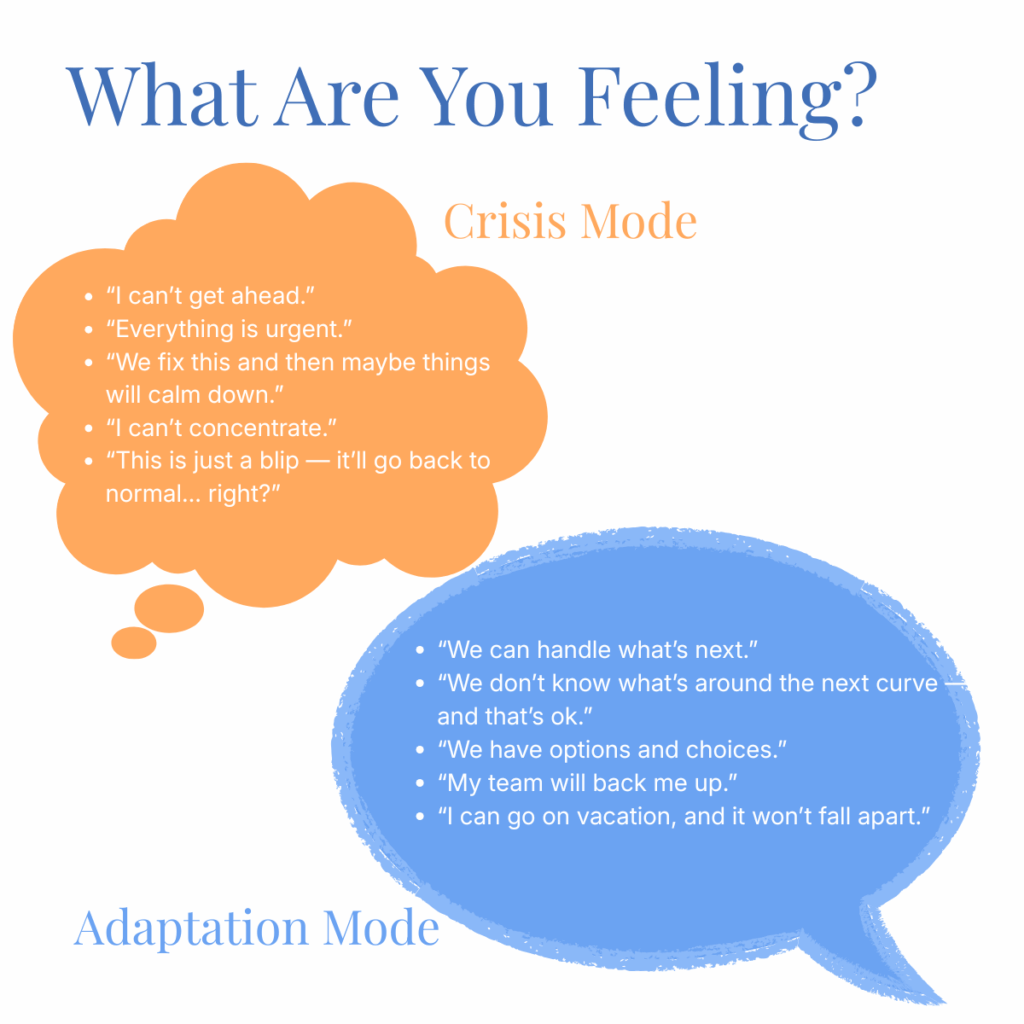
1. Crisis Mode vs. Adaptation Mode
Are you constantly firefighting or building adaptive systems?
Diagnostic: Compare the number of emergency meetings to strategic planning sessions in the last month.
If crisis mode outnumbers strategic mode, you’re not adapting — you’re surviving.
2. Functional Isolation vs. Integrated Response
Do you adapt across domains or only within silos?
True adaptation requires cross-functional thinking, not functional excellence.
Diagnostic: For your last three major decisions, map who was involved — and who should have been.
The delta is your integration gap.
3. Adaptive Capacity Distribution
Is adaptability concentrated in a few high performers or distributed across the team?
Teams with distributed adaptive skills outperform teams that rely on a few “go-to” leaders.
Diagnostic: If one person is absent, does execution slow down?
Or can the team rotate roles during disruption — what we call “when everyone can play drums”?
4. Learning Speed vs. Change Speed
Is your organization learning faster than the environment is changing?
Your adaptive advantage is the gap between the two.
Diagnostic: Measure time from insight to implementation across your last three initiatives.
If insights linger, you are losing momentum.
5. Innovation vs. Execution Balance
Are you optimizing the present at the expense of the future?
Many organizations maintain operational excellence while starving their exploratory muscle.
Diagnostic: Assess your investment ratio between core operations and future readiness initiatives.
If it’s 90/10, you are not preparing — you are preserving.
Part 4: The Framework — Building Adaptive Capacity
Adaptation isn’t an accident. It’s a capability you build.
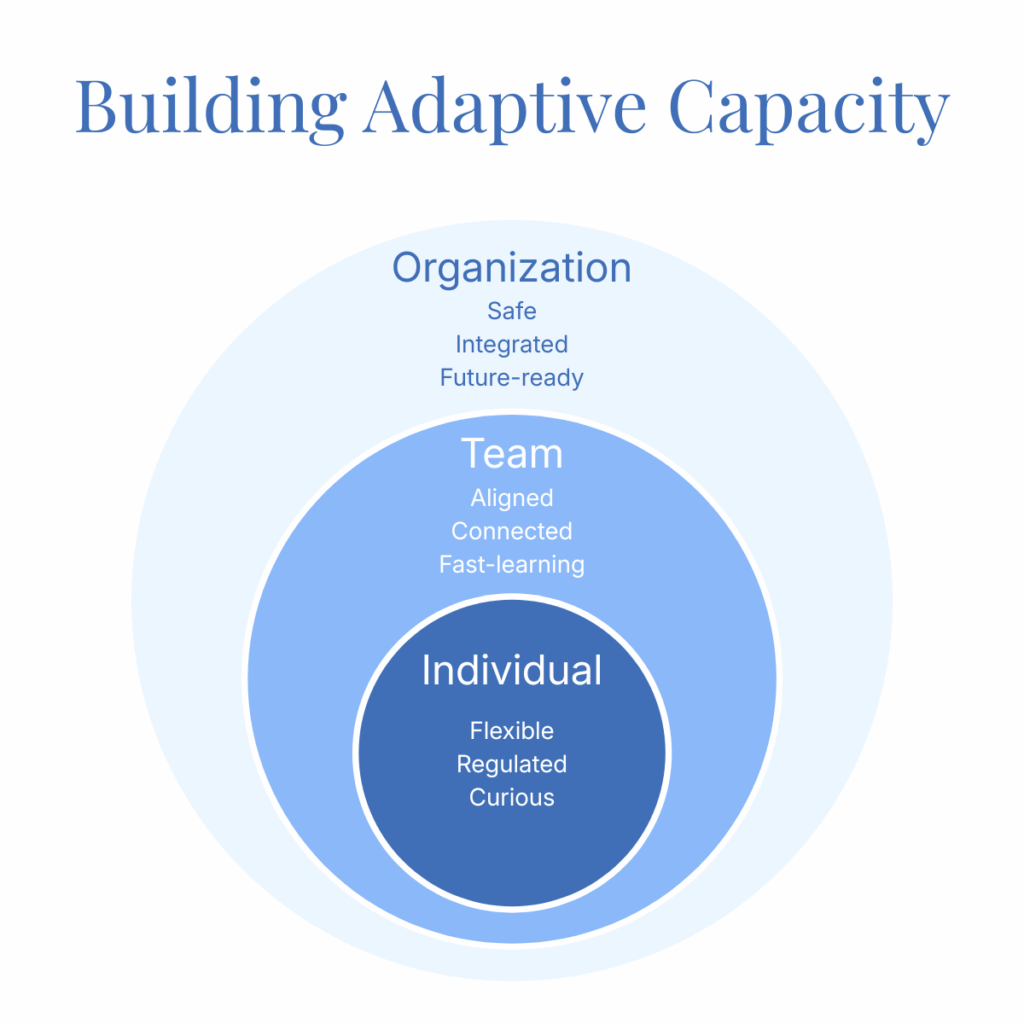
Here is a simplified, actionable model used in our Leadership Activation work with executives and teams.
Layer 1: Individual Adaptive Skills
Adaptive leaders demonstrate:
- Comfort with ambiguity
- Emotional regulation under pressure
- Cognitive flexibility (ability to scenario-switch)
- Willingness to release outdated assumptions
The paradox: the higher the stakes, the more leaders must let go of certainty to move forward.
Layer 2: Team Adaptive Systems
Adaptive teams rely on dynamic structures:
- Shared mental models that evolve as conditions shift
- Distributed decision-making protocols
- Rapid, real-time feedback loops
- Built-in opportunities to learn as they deliver
Teams become adaptive not through planning, but through practice.
Layer 3: Organizational Adaptive Culture
Culture is your adaptive engine.
Organizations that thrive in uncertainty:
- Invest in psychological safety
- Build integration mechanisms across teams
- Institutionalize “horizon scanning”
- Reward learning speed, not perfection
- Normalize reinvention
They understand the deeper truth: adaptability isn’t a risk. Inertia is.
The Courage to Compete vs. the Fear of Failure
Kodak didn’t die because it lacked innovation — it invented the digital camera.
It died because leaders couldn’t let go of what made them successful.
Adaptation requires courage:
- To release legacy thinking
- To cannibalize parts of your business before competitors do
- To invest in the future before the ROI is obvious
Adaptive leaders don’t bet on their current competence.
They bet on their capacity to reinvent.
Conclusion: Adaptation as Competitive Advantage
Adaptation isn’t a reaction to crisis.
It is a proactive leadership discipline.
In a world where change is continuous, the most valuable capability isn’t strength or intelligence — it’s adaptability.
The organizations that thrive are those that:
- Learn faster
- Integrate faster
- Experiment boldly
- Let go of what no longer serves
- Build leadership depth across the enterprise
This week, run your Adaptive Leadership Audit.
See where reinvention is already happening — and where you’re still relying on outdated patterns.
If you want to explore how your organization can strengthen adaptive capacity, I’d be glad to sit down with you, hear what’s happening in your world, and talk through what that could look like for your executive team.
The reinvention clock is ticking.
But with adaptive leadership, you can stay ahead of it.