
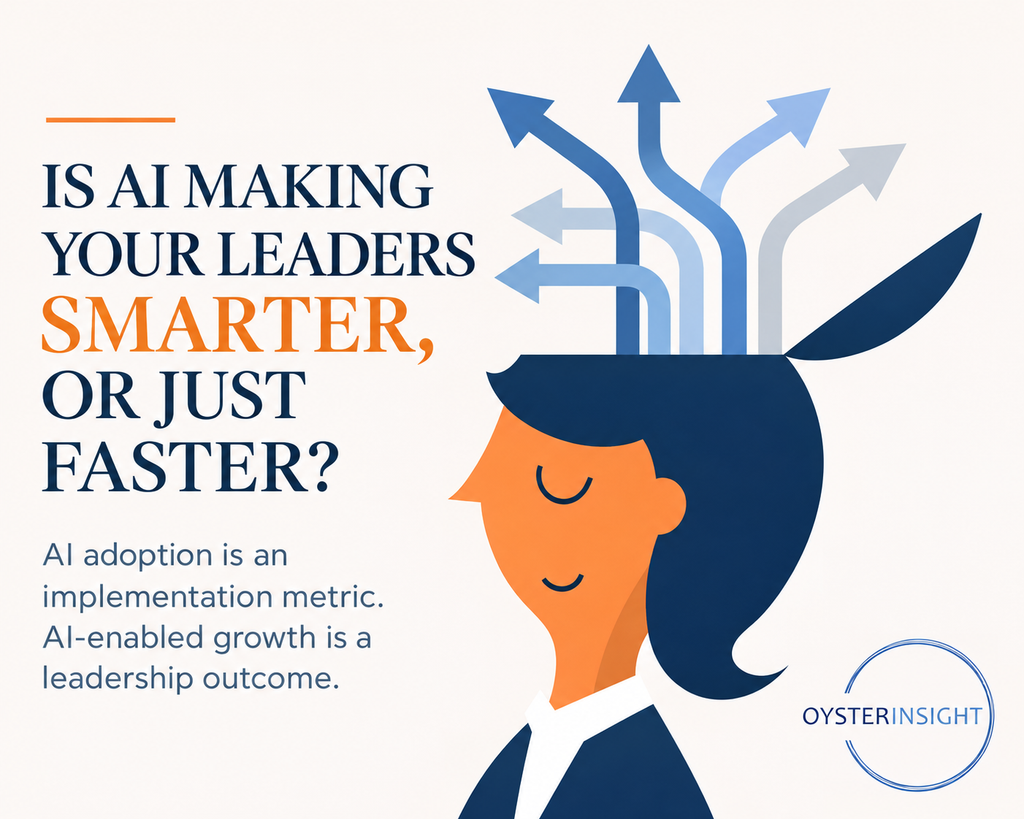
AI adoption is an implementation metric. AI-enabled growth is a leadership outcome.
In July, I wrote about a moment when I caught myself using AI not to sharpen my thinking, but to seek permission to trust my own judgment.
I wasn’t looking for another perspective. I was looking for reassurance.
That experience led me to explore why AI requires discernment, not certainty. We have extraordinary tools at our disposal, but we also have a responsibility to decide when to trust them, challenge them, or think for ourselves.
Since then, a bigger question has been occupying me.
If AI can subtly change how one experienced leader thinks, what happens when an entire executive team begins relying on it?
And what does that mean for an organization’s competitive advantage?
We’re measuring adoption. But are we measuring progress?
Consider two companies I’ve encountered.
One is implementing AI primarily to create efficiencies and reduce costs. Employees are on edge, worried about how their individual productivity will be measured and what AI might mean for their jobs.
Another is encouraging employees to play with AI. To experiment, challenge assumptions, and explore what more they might be able to accomplish.
Both are investing in AI. Both want results.
But they’re approaching the opportunity from very different directions.
Most organizations measure AI implementation through adoption and efficiency. How many people are logging in? How frequently are they using the tools? How much time and money are they saving relative to what they’ve invested?
Those are useful metrics. But they primarily tell us whether organizations are becoming more efficient at doing what they already do.
I’ve long argued that you can’t cut your way to growth.
Reducing expenses can improve margins. Streamlining operations can free up resources. Both are important.
But sustainable growth comes from creating new value. New offerings. New markets. New capabilities. New ways to serve customers.
And AI offers extraordinary possibilities for doing just that.
The question is whether our leadership approaches are encouraging people to discover those possibilities.
If employees see AI primarily as a tool for measuring their productivity and potentially replacing their jobs, how willing will they be to experiment, challenge assumptions, or explore unfamiliar ideas?
If they’re encouraged to be curious and discover what more they can do, what opportunities might emerge?
Are we measuring how efficiently people use AI to do today’s work, or whether AI is helping them imagine tomorrow’s?
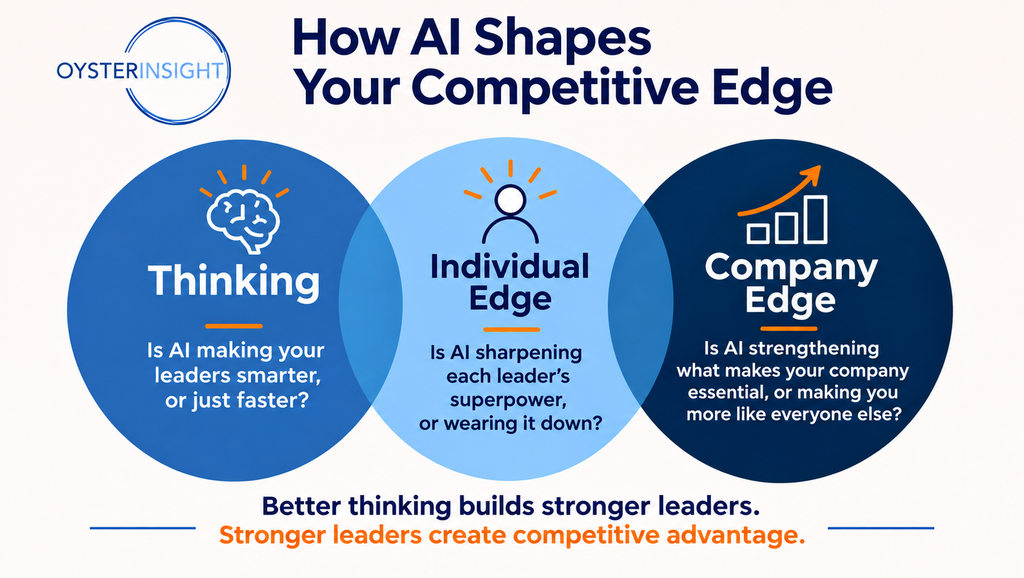
I believe three questions can help executive teams understand the difference.
1. Thinking: Is AI making your leaders smarter, or just faster?
I took a year off during college. Entirely by choice, I should add.
When I returned, I was an English major at a new college, with professors I adored. I threw myself into the classroom discussions. (If you’ve ever seen me at a Q&A, you can probably imagine.)
Then I submitted my first paper.
My professor didn’t hand it back with the others. He asked me to come see him.
In a single year, I’d apparently forgotten how to write even a decent college paper.
He gave me some pointers and a chance to try again.
I aced the rewrite.
I hadn’t lost my ability to think or write. I’d lost the practice of doing it well.
We know that skills deteriorate when we don’t exercise them. Research on GPS use, for example, has found associations between habitual reliance on turn-by-turn navigation and poorer spatial memory. We can get where we’re going without developing much understanding of how to navigate independently.
AI raises a similar concern.
When we ask it to summarize everything we read, draft everything we write, or solve problems before we’ve wrestled with them ourselves, we may be giving up more than the task.
We may be giving up the practice that keeps those abilities sharp.
Of course, nobody is suggesting that executives should write every first draft themselves or refuse to use AI for routine tasks.
The opportunity is to use AI to take on more demanding intellectual work, not simply avoid the work of thinking.
Imagine an executive using AI to challenge assumptions, explore unfamiliar perspectives, or test ideas that would otherwise be difficult to investigate.
That’s not outsourcing thinking. It’s expanding it.
Are your leaders using AI to expand their thinking, or outsource it?
2. Individual edge: Is AI sharpening each leader’s superpower, or wearing it down?
I once worked with a leader who, after four meetings, sheepishly admitted that he had ADHD.
I’d already suspected it.
What struck me wasn’t his diagnosis. It was the way he presented it, almost apologetically, as though he were revealing a weakness.
But I’d seen something else.
He had an extraordinary capacity to hyperfocus. When something captured his attention, he could immerse himself in it and become remarkably productive.
That was part of his superpower.
Every effective leader brings something distinctive to the table.
One sees connections others miss. Another reads people exceptionally well. Another has an instinct for operational risk or an unusual ability to turn complexity into clarity.
These capabilities develop through experience, practice, reflection, and sometimes uncomfortable mistakes.
AI creates an interesting paradox.
Used thoughtfully, AI could help that leader organize competing priorities, manage routine tasks, and create more room for the deep work where he excels.
It could help a gifted strategist test more scenarios, a creative leader explore more possibilities, or an analytical leader challenge a hypothesis from multiple directions.
But what happens when leaders routinely delegate the very work that develops their distinctive capabilities?
Consider a leader whose strength is synthesizing complex information. If AI produces every synthesis, what happens to that leader’s ability to recognize patterns independently?
Or a leader known for persuasive communication who begins relying on AI to frame every difficult conversation?
I’m not suggesting executives should continue doing work that technology can accomplish more efficiently. That would miss the point.
The challenge is distinguishing between work that can be delegated and thinking that needs to be exercised.
When I work with leaders, I’m often struck by how much of their effectiveness comes from capabilities they don’t necessarily recognize as unusual. What seems instinctive to them may be precisely what makes them valuable.
The opportunity with AI isn’t simply to make these leaders more productive.
It’s to amplify what makes them exceptional and enable them to accomplish things they couldn’t before.
Is AI sharpening each leader’s superpower, or wearing it down?
3. Company edge: Is AI strengthening what makes your organization essential, or making you more like everyone else?
This may be the most consequential question of all.
Your competitors have access to many of the same AI tools your organization does.
They can generate similar market analyses, strategic frameworks, customer communications, and operating recommendations.
If everyone relies on similar systems to interpret information and recommend action, organizations risk converging in how they think.
Efficiency improves, but differentiation can erode.
A company’s competitive advantage is rarely just its technology. It’s the accumulated judgment, relationships, expertise, culture, and insight that allow it to deliver something competitors cannot easily replicate.
AI should make those capabilities more powerful.
But there’s a difference between using AI to become better at what makes your company distinctive and using AI to become better at doing what everyone else does.
The former can strengthen competitive advantage.
The latter may simply help you keep pace.
And I think there’s an even greater opportunity.
What if AI could help your organization do something your competitors haven’t imagined?
What if the expertise you’ve spent decades developing could be applied to a new market? What if your understanding of customers could lead to an entirely new offering? What if your employees, given the freedom to experiment, discovered capabilities that fundamentally changed how your company creates value?
Those possibilities don’t emerge simply because employees have access to AI.
They emerge when leaders encourage curiosity, create room for experimentation, challenge conventional thinking, and recognize promising ideas.
And this is where individual leadership habits become an organizational issue.
If your executive team routinely accepts AI-generated frameworks without challenging their underlying assumptions, whose strategy are you actually developing?
If leaders focus exclusively on productivity and cost reduction, who is looking for the next source of growth?
Are your leaders using AI to strengthen what makes your company essential, or making you more like everyone else?
The leadership challenge isn’t adoption. It’s activation.
I’ve spent much of my career helping executive teams recognize the gap between what they intend to do and what actually happens in their organizations.
An executive team can understand the importance of collaboration and still operate in silos.
Leaders can agree that challenging assumptions is valuable and still avoid difficult conversations.
They can embrace innovation and continue making decisions exactly as they always have.
Knowledge doesn’t automatically change behavior.
AI is no different.
An organization can have an ambitious AI strategy, invest heavily in tools, and train its employees extensively without ever examining whether those investments are improving the way its leaders think.
The technology changes.
The leadership habits may not.
Or worse, they may change in ways nobody intended.
Think about what leaders signal when they introduce AI.
Is the message primarily about doing more with less? Or is it also about discovering possibilities, developing capabilities, and creating new value?
Neither efficiency nor experimentation is inherently wrong. Organizations need both.
But the way leaders frame AI helps determine how people engage with it.
Employees who worry that AI will replace them may be reluctant to experiment or share what they’ve discovered. Employees who are encouraged to explore may be more willing to challenge assumptions and contribute new ideas.
And leadership must do more than encourage experimentation. It must recognize which discoveries matter, connect them to strategic priorities, and turn promising ideas into organizational capabilities.
AI adoption is an implementation metric. AI-enabled growth is a leadership outcome.
Getting from one to the other requires more than technology. It requires deliberate leadership behaviors.
A different way to assess your AI advantage
This is why I’ve developed the AI Leadership Edge, a focused diagnostic that helps executive teams examine three questions:
- Thinking: Is AI making your leaders smarter, or just faster?
- Individual edge: Is AI sharpening each leader’s superpower, or wearing it down?
- Company edge: Is AI strengthening what makes your company essential, or making you more like everyone else?
The assessment combines a Leadership Thinking Survey, a 60-minute executive debrief, and a one-page summary of findings to identify patterns, strengths, and potential risks in how leaders are thinking with AI.
It’s designed for organizations with 150 or more employees that want to look beyond adoption metrics and examine what AI may be changing in their leadership teams.
Because I don’t believe the organizations that benefit most from AI will necessarily be the ones that adopt it fastest.
Or the ones that cut the most costs.
They’ll be the ones that use AI to make their people more capable, their organizations more distinctive, and their possibilities for growth greater.
Explore the [AI Leadership Edge Assessment](INSERT OFFER PAGE URL) from Oyster Insight.
Research referenced
- Dahmani, L., & Bohbot, V. D. (2020). Habitual use of GPS negatively impacts spatial memory during self-guided navigation. Scientific Reports. https://pmc.ncbi.nlm.nih.gov/articles/PMC7156656/
- Miola, L., et al. (2024). GPS use and navigation ability: A systematic review and meta-analysis. Journal of Environmental Psychology. https://doi.org/10.1016/j.jenvp.2024.102417